Claim acknowledgment reference
What Is an EDI 277CA File?
Understand how a 277CA reports claim-submission status, where it appears in the healthcare EDI workflow, and what its results do—and do not—mean.
An EDI 277CA is an X12 Health Care Claim Acknowledgment used to report whether submitted claim information was received and accepted or rejected for further processing. The 005010X214 transaction can carry status at transaction, provider, claim, and service-line levels. It is an acknowledgment before adjudication: acceptance does not prove coverage, medical necessity, final claim approval, or payment.
Where the 277CA fits in the claim workflow
A provider, billing service, or clearinghouse sends an EDI 837 claim transaction. A receiver can return a 999 Implementation Acknowledgment to report implementation-level syntax status, then a 277CA to describe acknowledgment results tied to the healthcare-claim content. Depending on the trading-partner workflow, the 277CA may come from a clearinghouse, payer gateway, or another claim receiver.
The sender uses the acknowledgment to identify submissions that moved forward and submissions requiring investigation. A later EDI 835 remittance or another claim-status workflow addresses adjudication and payment. The 277CA should therefore be treated as an intake-status document, not a remittance advice.
Operational rule: preserve the original 837 identifiers alongside the 277CA. Control numbers, trace values, provider identifiers, and patient or claim controls help connect an acknowledgment occurrence to the submitted data it describes.
How a 277CA is organized
The transaction uses hierarchical levels so a receiver can report broad and specific results in one acknowledgment. Exact content varies by the submitted claims and trading-partner rules, but mapped data commonly exposes these scopes:
| Scope | Useful context | Question it answers |
|---|---|---|
| Information source | Payer or receiver identity, receipt trace, dates, and totals | Who produced the acknowledgment? |
| Information receiver | Submitter identity and referenced 837 transaction | Which submission channel is being acknowledged? |
| Provider | Billing-provider identity, provider trace, counts, amounts, and STC status | Which provider grouping is affected? |
| Patient or claim | Patient and claim controls, dates, amounts, and claim-level STC occurrences | Which claim has this result? |
| Service line | Line control, procedure context, service date, amount, and line-level STC | Which service occurrence needs review? |
HL segments establish hierarchy; NM1 identifies parties; TRN carries trace references; and STC communicates acknowledgment status. DTP, QTY, AMT, SVC, and REF occurrences can add dates, counts, amounts, service, and identifier context. A code must be interpreted with its composite position and hierarchy rather than as a free-standing label.
Synthetic EDI 277CA example
This fictional 005010X214 excerpt reports an accepted acknowledgment result. Values belong to synthetic organizations and do not identify a real person or claim:
ST*277*0001*005010X214~
BHT*0085*08*ACK000001*20260725*1030*TH~
HL*1**20*1~
NM1*PR*2*SYNTHETIC HEALTH PLAN*****PI*SHP001~
TRN*1*RCPT000001~
HL*2*1*21*1~
NM1*41*2*SYNTHETIC SUBMITTER*****46*SUB0001~
TRN*2*837BHT000001~
STC*A1:19:PR*20260725*WQ*125.5~
SE*10*0001~
ST identifies the transaction as 277 using implementation 005010X214. BHT supplies acknowledgment-purpose context. The HL and NM1 occurrences identify the receiver-to-submitter hierarchy, TRN links the acknowledgment to trace information, and STC supplies the reported status. Real files can continue into provider, patient, claim, and service-line levels.
How to read 277CA status information
Start with scope, then read the STC composite and its adjacent context. The first composite component is a status category, another component gives a more specific status, and an entity component can identify the party or object associated with that status. Dates, action codes, amounts, repeated STC occurrences, and the enclosing hierarchy can materially change the interpretation.
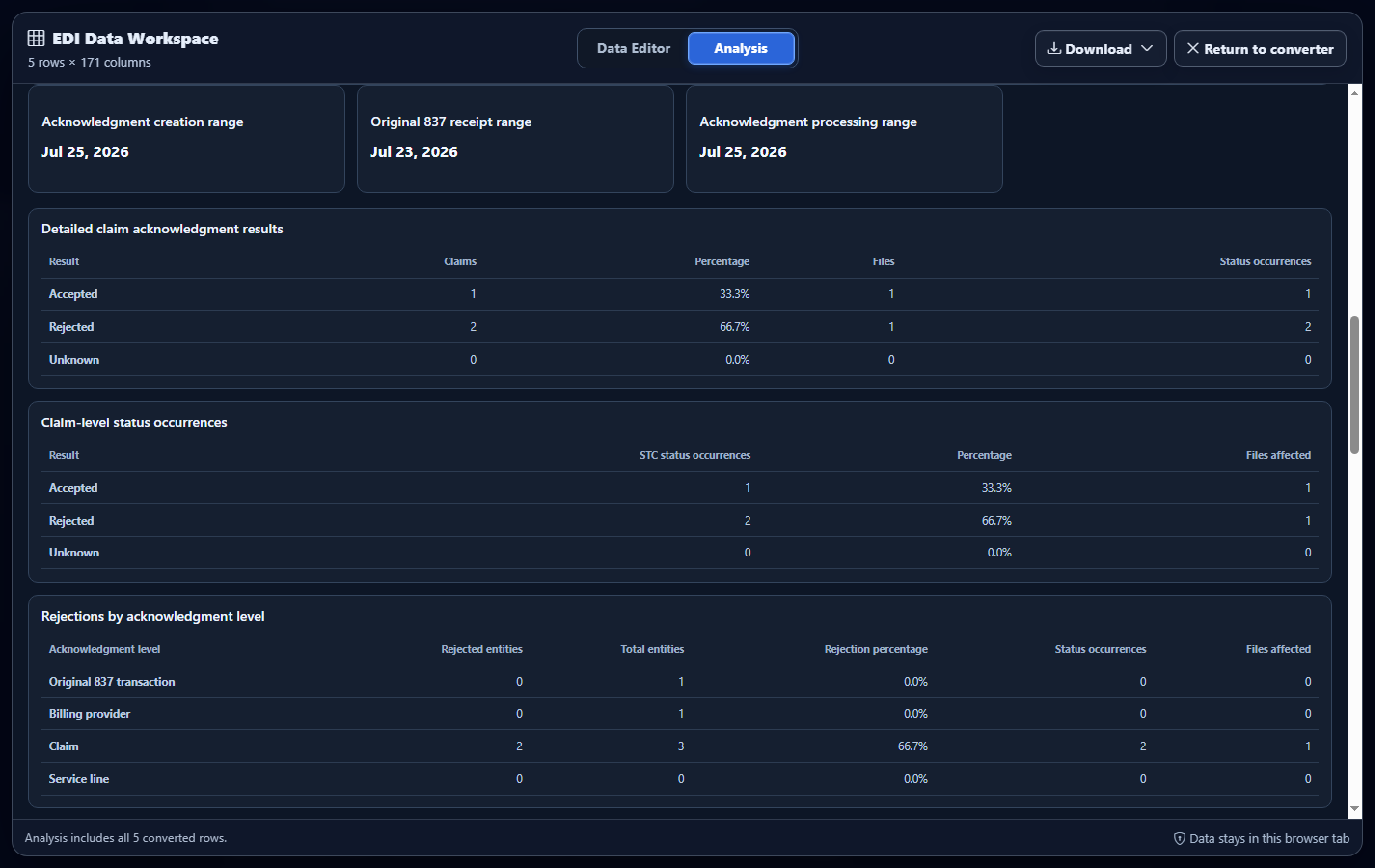
Do not collapse a multi-status claim into the first code found. A claim can have more than one reported status, and a transaction can contain a mixture of accepted and rejected claims or service lines. For operational reporting, retain the status occurrence number, acknowledgment level, trace controls, claim or line control, category/status/entity descriptions, and affected file.
EDI 277CA compared with 999, 837, and 835
| Transaction | Role | What it does not establish |
|---|---|---|
| 837 claim | Submits professional, institutional, or dental claim information | Receipt, acceptance, adjudication, or payment |
| 999 acknowledgment | Reports implementation-level syntax acknowledgment | Claim-specific business acceptance or payment |
| 277CA acknowledgment | Reports claim-submission acknowledgment results at applicable hierarchy levels | Final adjudication, coverage, or payment |
| 835 remittance | Explains adjudicated payments, denials, and adjustments | The earlier intake sequence by itself |
Common 277CA interpretation mistakes
Assuming accepted means paid
An accepted acknowledgment indicates that submitted information passed the reported intake stage. Review an 835 or the appropriate claim-status workflow for adjudication and payment information.
Reading STC without hierarchy
The same-looking code can apply to a transaction, provider, claim, or service line. Keep acknowledgment level, HL ownership, trace values, and business controls with every status occurrence.
Treating reported rejection content as a malformed 277CA
A structurally valid acknowledgment can legitimately report rejection of the original 837. Separate source-file validation issues from rejection reasons communicated by the sender.
Discarding repeated statuses
Repeated STC occurrences can contribute distinct information. Preserve occurrence order and related category, status, entity, date, action, and amount fields during conversion or aggregation.
Frequently asked questions
What does an EDI 277CA acknowledge?
It reports receipt and acceptance or rejection status for submitted healthcare-claim information at applicable transaction, provider, claim, or service-line scope.
Does an accepted 277CA mean a claim will be paid?
No. It does not establish coverage, adjudication, medical necessity, or payment.
How is a 277CA different from a 999?
A 999 addresses implementation-level syntax acknowledgment. A 277CA provides claim-oriented acknowledgment status and can identify affected claims or service lines.
Which implementation is commonly called the 277CA?
This guide covers the X12 005010X214 Health Care Claim Acknowledgment.
Can one 277CA contain mixed outcomes?
Yes. Different claims or service lines in one acknowledgment can have different reported results.