Eligibility-response analysis guide
How to Analyze an EDI 271 File
Read benefit and rejection occurrences with their patient, service, date, message, amount, percentage, and network context.
To analyze an EDI 271 file, convert a supported 005010X279A1 response with Smart Mapping, open Analysis, and review each EB benefit or AAA rejection occurrence in its owning subscriber or dependent context. Use the occurrence-aware date and message tables for every preserved benefit DTP and MSG; review EB03 service repetitions, EB07 amounts, EB08 percentages, EB12 network indicators, and related entities without combining unlike business meanings.
What EDI 271 analysis shows
An EDI 271 Eligibility, Coverage or Benefit Response carries information returned for an eligibility inquiry. The 005010X279A1 hierarchy identifies the information source, receiver, subscriber, and, when present, dependent. EB occurrences carry eligibility and benefit details; AAA occurrences carry rejection or processing details at their source hierarchy level.
Analysis summarizes protected Smart Mapping rows: physical files, transactions, patients, EB benefits, AAA rejections, EB03 service occurrences, related entities, benefit DTP occurrences, benefit MSG occurrences, EB12 network status, and separate amount and percentage signals. It does not contact a payer, change the source, or prove future coverage or payment.
Smart Mapping uses one row per EB or AAA occurrence. Multiple EB03 service types remain on the owning EB row and are counted as service occurrences. A member with no EB or AAA produces no Smart Mapping detail row.
Keep each response detail in its owning context
| Context | Fields to verify | Interpretation safeguard |
|---|---|---|
| Transaction | ST control, BHT response reference, trace, implementation reference. | Count the ST/SE transaction once even when it contains many details. |
| Patient | Response Level, Patient Type, member identifier, subscriber/dependent identity. | Several EB or AAA rows can belong to one patient. |
| EB benefit | Response Detail Number, EB01-EB13, HSD, REF, DTP, MSG, related entities. | Keep dates, messages, services, and financial values attached to this EB occurrence. |
| AAA rejection | Request Validation Number, hierarchy level, AAA01-AAA04. | A valid AAA row is response content, not a claim acknowledgment or a malformed benefit. |
Start with a stable trace or member identifier, then verify Response Level, Patient Type, and Response Detail Number. Date analysis uses one source DTP occurrence under one EB; message analysis uses one MSG segment under its owning EB, including a valid MSG after a benefit-level AAA. Unknown date qualifiers remain raw rather than receiving an invented business label.
Important: EB07 amounts are context-specific. Do not sum deductibles, copays, limitations, benefits, time periods, or service types unless the business context actually supports aggregation. EB08 retains its raw fractional value; presentation may display .20 as 20%.
Synthetic response example and analysis result
The synthetic 271 used for the screenshots contains fictional organizations, patients, identifiers, and dates. It reports benefit information for a synthetic subscriber:
ST*271*000000001*005010X279A1~
BHT*0022*11*REF000001*20260726*1030~
TRN*1*000000000001*1999999999~
NM1*IL*1*SAMPLE*ALICE****MI*000000000123~
DTP*291*D8*20260726~
EB*1*IND*30^47**PLAN COVERAGE*23*1000*.20***Y~
DTP*291*RD8*20260701-20260731~
DTP*346*D8*20260701~
MSG*FIRST BENEFIT NOTE~
MSG*SECOND BENEFIT NOTE~
Analysis keeps both EB03 services in source order, reports the amount and percentage separately, derives network only from EB12, and exposes both DTP and MSG occurrences under this EB. RD8 remains a range source string; D8 remains a single-date source string.
Analyze converted 271 data in EDIFileConverter.com
- Open the EDI converter. Add an authorized 271 using Browse files or Drag & drop EDI files. Processing occurs in the browser tab.
- Keep Smart Mapping selected. Exact ST03
005010X279A1is supported. If ST03 is blank, exact GS08005010X279A1is the fallback. Near-match and unsupported versions are Raw-only. - Select Convert & Preview. Verify transaction type, Record Type, Response Level, patient identifiers, and Response Result.
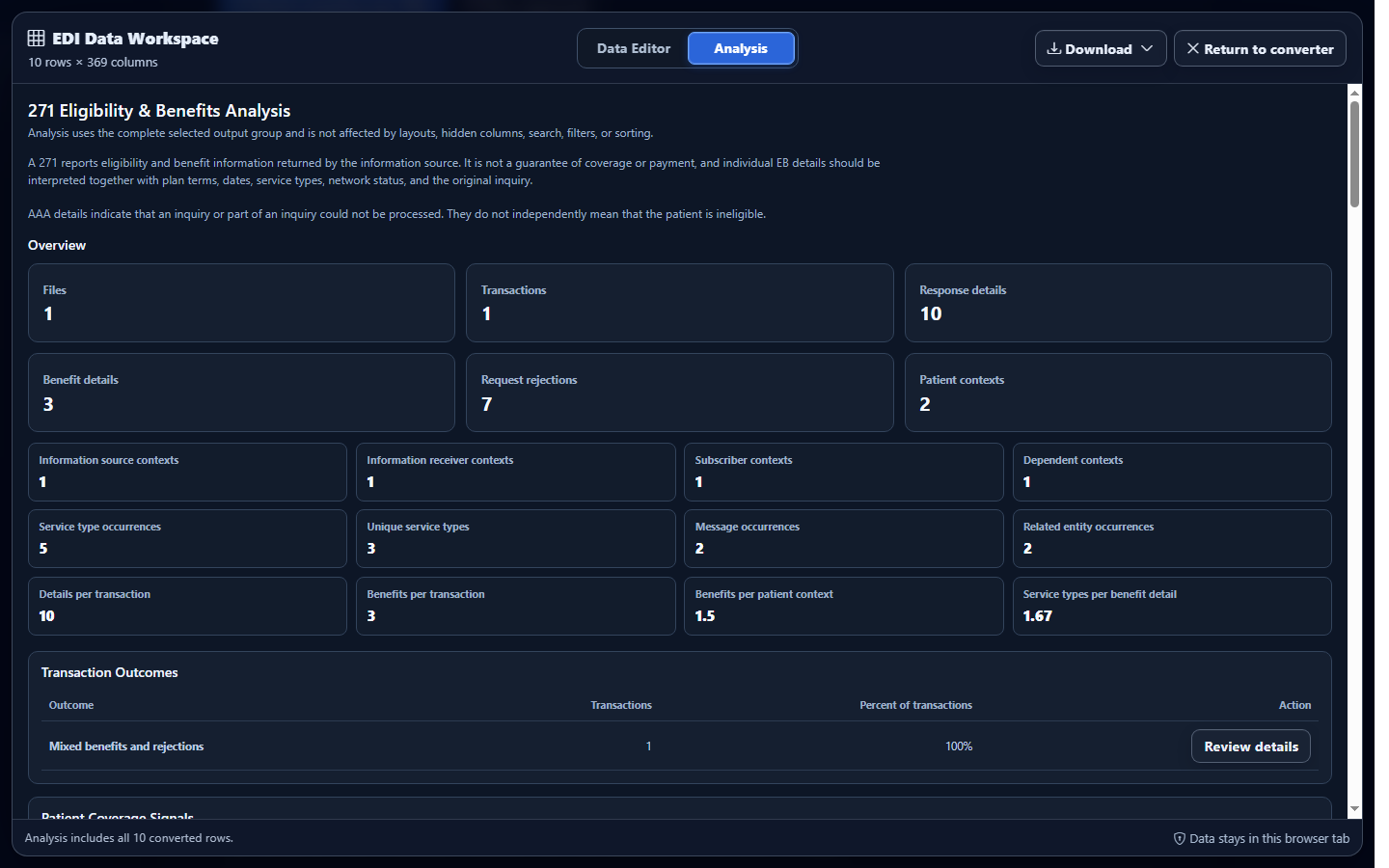
- Open the full workspace and select Analysis. Review overview counts before interpreting detailed tables.
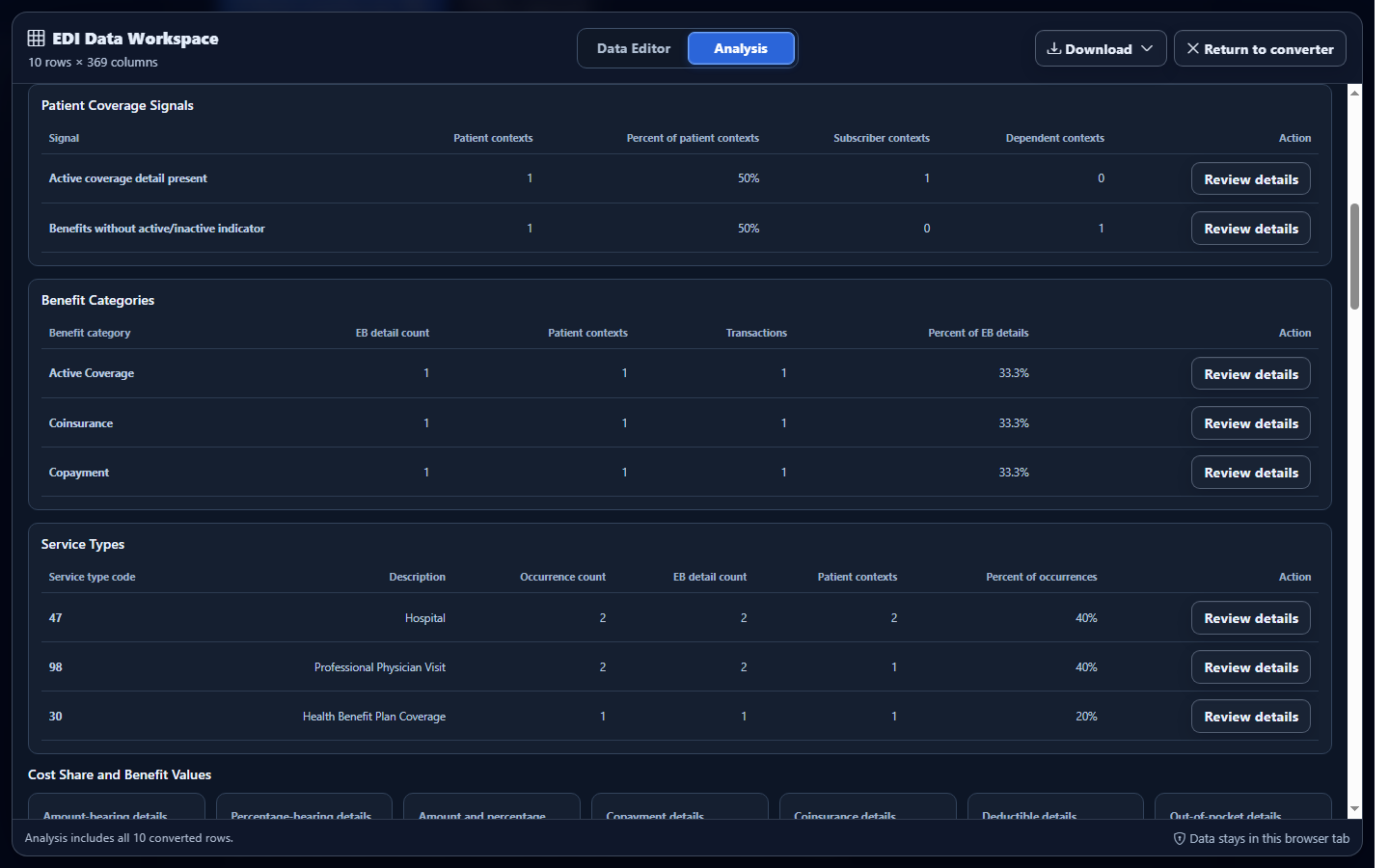
- Inspect occurrence tables. Benefit Dates lists qualifier, format, source value, display value, and EB detail. Benefit Messages lists every protected MSG in source order. Service and network tables retain their own EB context.
- Drill into the response detail. Use the detail explorer and Data Editor to confirm dates, messages, financial signals, and related entities belong to the intended EB or AAA occurrence.
Interpret metrics without double-counting response details
Patient count uses patient occurrence identity, benefit count uses EB occurrence identity, and rejection count uses actual AAA rows. Service count intentionally expands repeated EB03 codes, but does not create extra Smart Mapping rows. Related-entity and network summaries retain EB ownership; network status comes only from EB12, never from provider information.
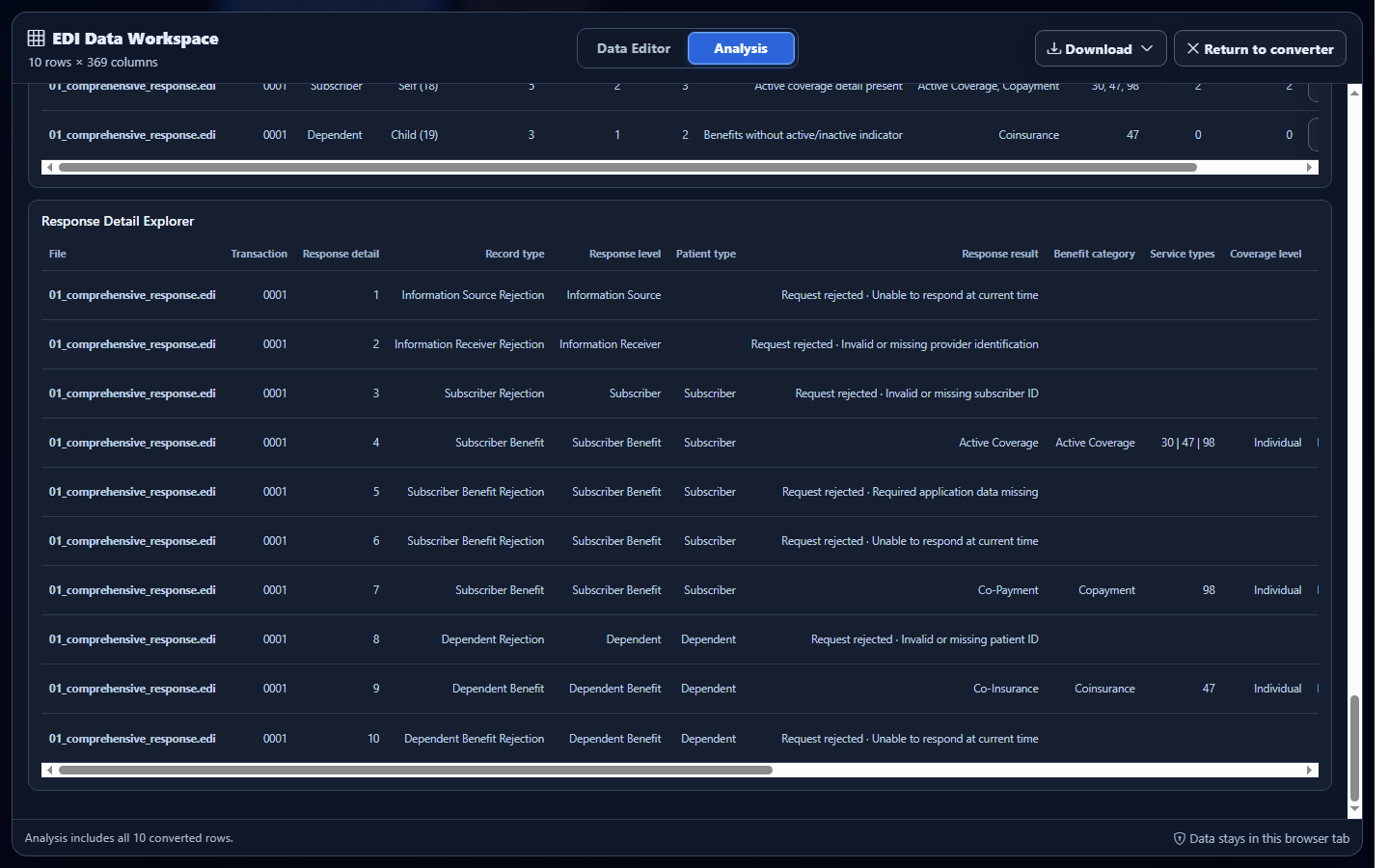
The Summary deliberately does not create a global total across heterogeneous EB07 amounts or EB08 percentages. Use the 369-field Smart Mapping output for field-level review. That schema is the converter's current projection, not exhaustive X279A1 support, and there is no separate Key schema.
Common 271 analysis mistakes
Counting every EB row as a patient
What you see: more response rows than people. Why it matters: one patient can own many EB and AAA occurrences. Correction: use patient metrics for people and response-detail metrics for rows.
Summing unlike financial values
What you see: one dollar total across deductibles, copays, limitations, benefits, services, and periods. Why it matters: EB07 meaning depends on its owning EB. Correction: analyze the amount with EB01, EB03, EB06, dates, and network context.
Reading only the first date or message
What you see: a convenience field is mistaken for the complete benefit context. Why it matters: one EB may own multiple DTP and MSG segments. Correction: use the occurrence-aware Benefit Dates and Benefit Messages tables or the serialized all-occurrence fields.
Inferring network from a provider
What you see: provider information used as a network classification. Why it matters: the mapper derives network status only from EB12. Correction: retain unknown or not-specified status when EB12 does not provide a supported value.
Frequently asked questions
Does Analysis rewrite the original EDI 271?
No. It reads the converted Smart Mapping rows; the uploaded X12 source remains unchanged.
What does one response-detail row mean?
One EB benefit occurrence or one AAA rejection occurrence with applicable parent and patient context.
Which implementation is supported?
Exact 005010X279A1 in ST03 is supported. A blank ST03 uses exact GS08 005010X279A1 as fallback; other versions are Raw-only.
Are multiple dates and messages visible?
Yes. The current Benefit Dates and Benefit Messages tables expose each supported occurrence retained on its owning EB row.