277CA validation guide
How to Validate an EDI 277CA File
To validate an EDI 277CA file, check the X12 envelopes and transaction controls, confirm the 005010X214 transaction structure and hierarchy, test dates, amounts, codes, and status dependencies, then review reported acknowledgment reasons separately. A rejected claim status can be valid content inside a well-formed 277CA; it does not by itself make the acknowledgment file invalid.
What 277CA validation means
The ASC X12 277CA Health Care Claim Acknowledgment uses the 005010X214 implementation of the 277 transaction. A payer, clearinghouse, or other information source sends it without a 276 inquiry to report whether previously submitted 837 claim data entered pre-processing. Results can appear at the transaction, provider, claim, and service-line levels.
Validation answers two different questions. Source conformance asks whether the 277CA itself has coherent envelopes, hierarchy, dates, codes, and values. Acknowledgment review asks what the 277CA says about the original 837. Keep those questions separate: a syntactically readable acknowledgment can correctly report a transaction rejection.
A 999 is nearby but not interchangeable. It mainly acknowledges X12 implementation syntax and structure. A 277CA adds claim-oriented status context. Neither an accepted 999 nor an accepted 277CA proves adjudication or payment; downstream status and remittance workflows answer later lifecycle questions.
What to check in a 005010X214 file
| Validation area | Representative check | Why it matters |
|---|---|---|
| Envelope controls | ISA13/IEA02, GS06/GE02, and ST02/SE02 agree; trailer counts match. | Broken controls can prevent reliable interchange, group, or transaction processing. |
| Implementation identity | ST01 is 277; ST03 is exactly 005010X214, or ST03 is blank and GS08 is exactly 005010X214. | Near matches and other 277 implementations are Raw-only and must not be treated as a 277CA Smart projection. |
| Core transaction | BHT is present and BHT04 is a real CCYYMMDD date; BHT05 is HHMM or HHMMSS. | The beginning segment identifies and dates the acknowledgment transaction. |
| Hierarchy | Every HL has an ID, parent references resolve, IDs do not duplicate, and expected levels use 20, 21, 19, or PT. | STC meaning depends on its transaction, receiver, provider, patient, claim, or service context. |
| Status content | STC01 carries a status composite; accepted higher-level statuses use WQ and rejected statuses use U. Rejected 2220D service issues use allowed service action semantics. | A service-line rejection is not a final payment denial. Provider-level TRN and STC are situational, not universally required. |
| Dates and ranges | D8 is one CCYYMMDD date; RD8 is a CCYYMMDD-CCYYMMDD range with real dates and nondecreasing range order. ISA09 is YYMMDD. | These distinct X12 formats must not be conflated. |
| Numbers | Signed decimal values and X12 real-number forms such as .1 and 1. are accepted where applicable. | 277CA numeric checks do not impose nonnegative 835 payment semantics. |
These are useful checks, not a substitute for the licensed implementation guide or a trading partner’s companion guide. A payer can impose additional situational rules, code restrictions, or response conventions.
Controlled invalid example and validator result
This fictional extract preserves the status hierarchy but deliberately uses an impossible creation date in BHT04. It contains no real protected health information (PHI).
Invalid source
ST*277*0004*005010X214~
BHT*0085*08*ACK000004*20260230*1115*TH~
HL*1**20*1~
NM1*PR*2*SYNTHETIC HEALTH PLAN*****PI*SHP001~
HL*2*1*21*0~
NM1*41*2*TEST SUBMITTER*****46*SUB0004~
STC*A3:24:41*20260228*U*500~
SE*8*0004~
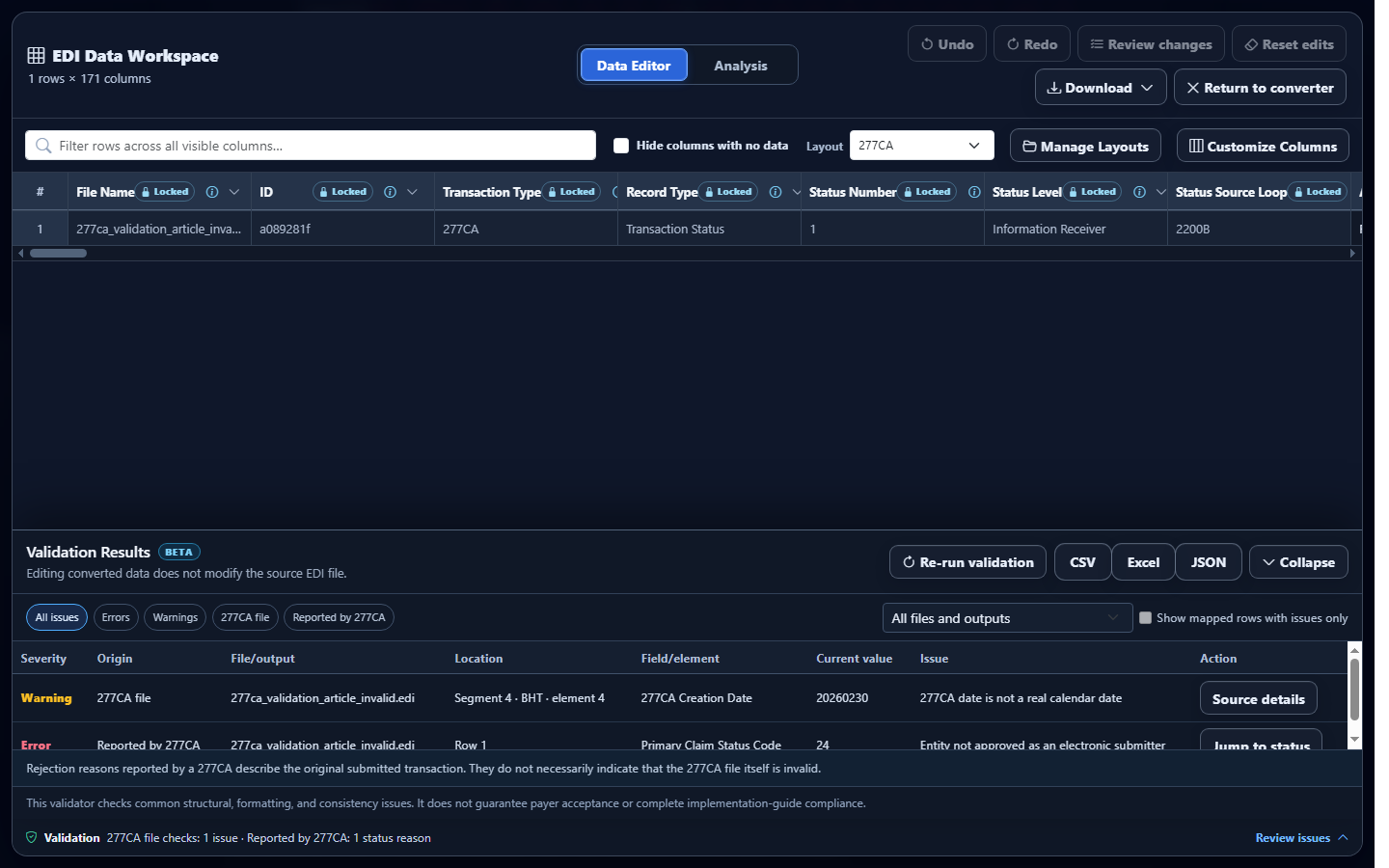
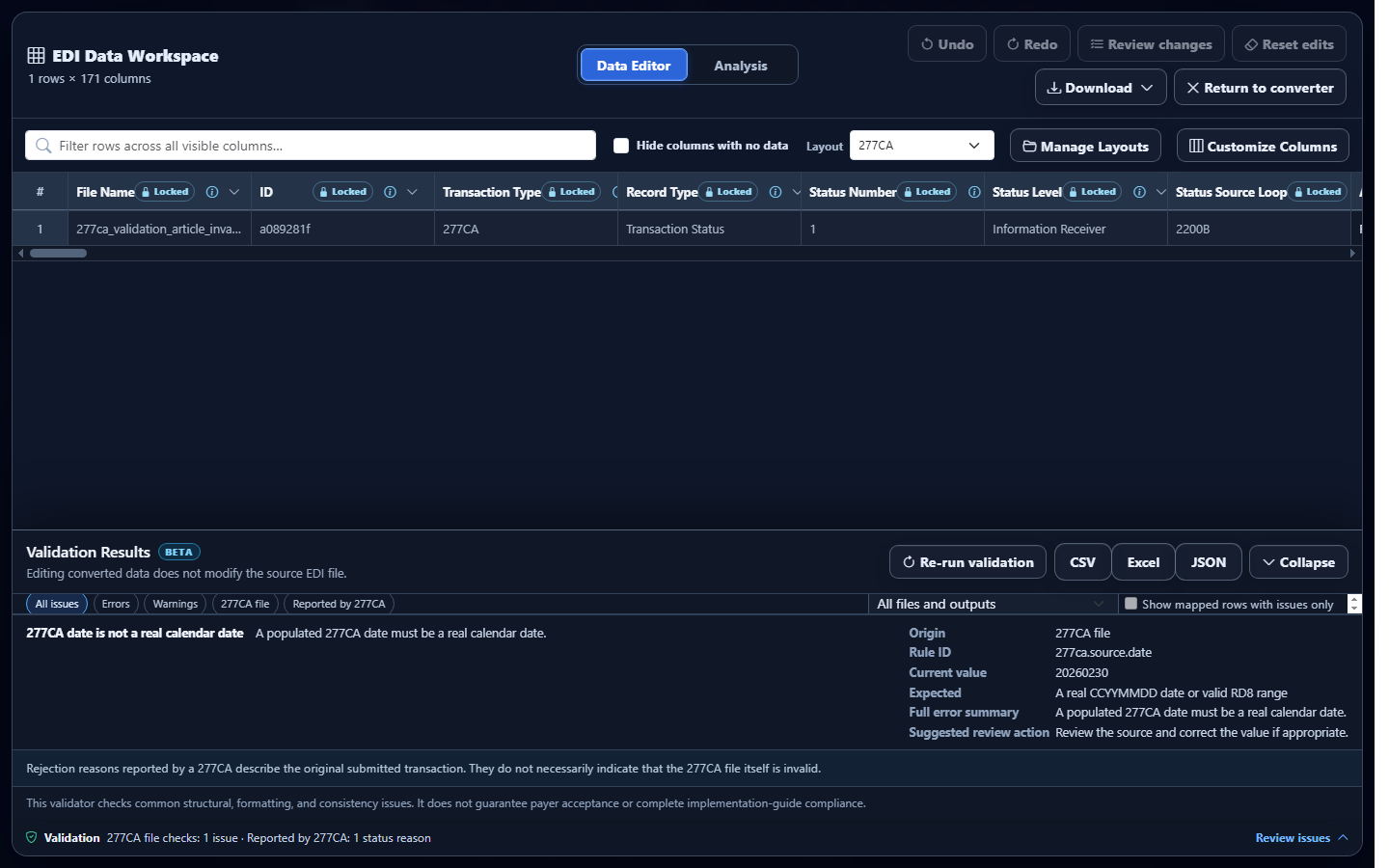
Observed validator result: the enabled checks create a warning titled 277CA date is not a real calendar date, locate it at BHT element 4, retain the current value 20260230, and expect a real CCYYMMDD date or valid RD8 range.
Corrected source
ST*277*0004*005010X214~
BHT*0085*08*ACK000004*20260228*1115*TH~
HL*1**20*1~
NM1*PR*2*SYNTHETIC HEALTH PLAN*****PI*SHP001~
HL*2*1*21*0~
NM1*41*2*TEST SUBMITTER*****46*SUB0004~
STC*A3:24:41*20260228*U*500~
SE*8*0004~
Changing BHT04 to the real date 20260228 clears that date warning when validation is rerun. The A3:24:41 status still reports a rejection about the original submission. That reported reason belongs in the acknowledgment review and is not “fixed” by changing the acknowledgment.
Validate the 277CA in EDIFileConverter.com
- Open the EDI converter and validator. Add the synthetic or business 277CA with Browse files or the Drag & drop EDI files area.
- Use Smart mapping (per file). The application identifies 005010X214 from the implementation reference and maps transaction, provider, claim, and service-line status occurrences.
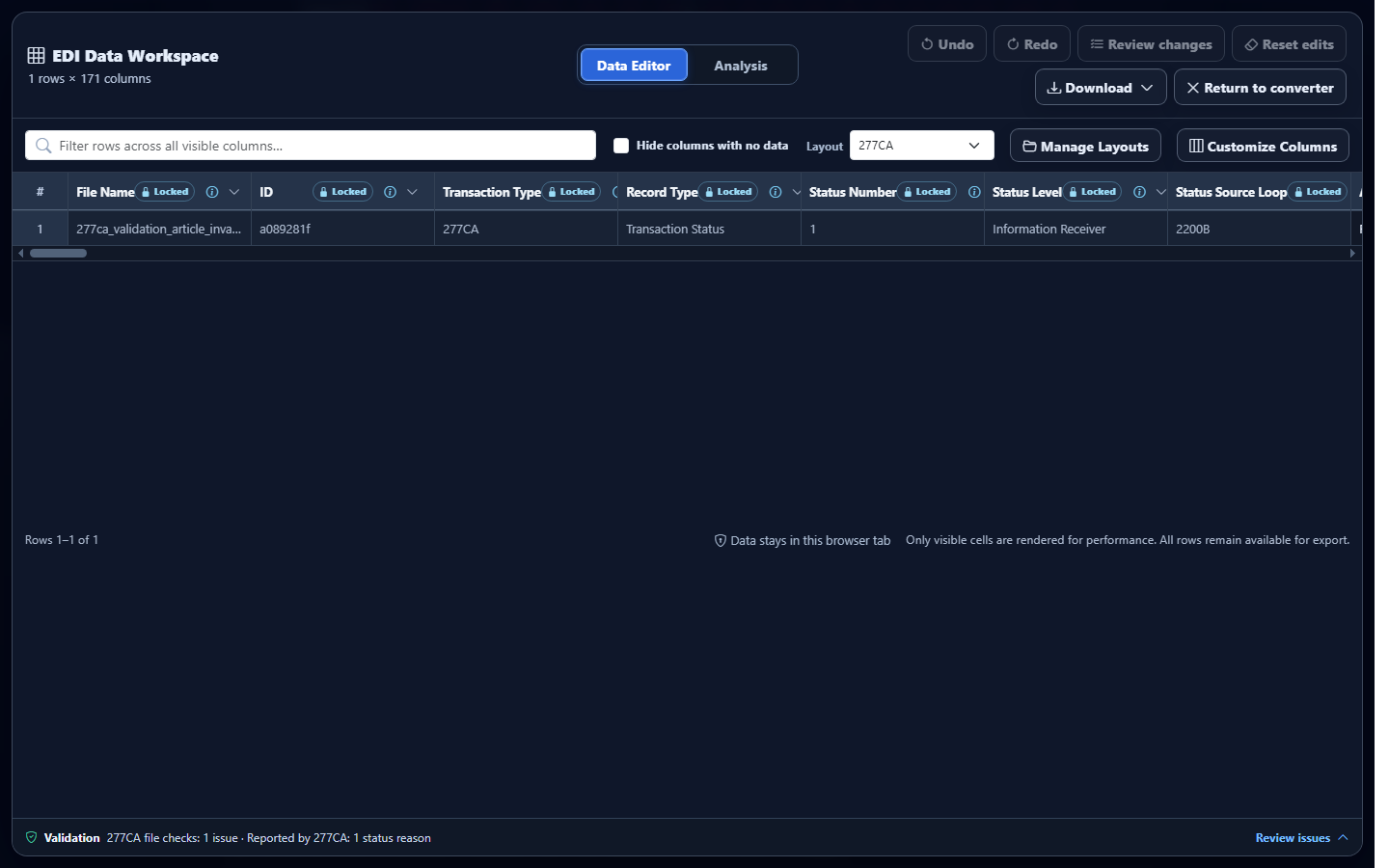
- Select Convert & Preview. Confirm that Converted results identifies the output as 277CA, then spot-check control numbers and status fields.
- Select Open full editor. Validation runs against the uploaded source and converted output. Expand Validation to open Validation Results.
- Separate the filters. Use 277CA file for defects in the acknowledgment and Reported by 277CA for status reasons about the original submission. Errors and Warnings narrow severity.
- Open the issue action. Source details shows the rule, location, current value, expected value, full summary, and suggested review action. A reported status instead offers Jump to status.
- Correct the right artifact. Correct source-conformance defects in the system that produced the 277CA. For reported rejection reasons, investigate and correct the original 837 submission using the applicable companion guide.
- Rerun and document. Replace the corrected source file and choose Re-run validation. Eligible plans can export a validation report as CSV, Excel, or JSON; the report may include field values containing PHI.
How to interpret the validation results
Error and warning are validator severity levels; neither is proof that every trading partner will reject or accept the file. If the summary says no issues were found by the enabled checks, treat that as a scoped result—not universal certification.
The most important 277CA distinction is the Origin column. Source EDI means the validator found a structural, formatting, or code concern in the uploaded acknowledgment. Reported by 277CA means the acknowledgment itself supplied an STC reason about the original transaction, provider, claim, or service line.
STC01 is composite: its parts can identify a status category, claim status, and entity. Read the parts together and within the surrounding HL hierarchy. A service-line reason must not be casually promoted to a whole-claim rejection, and repeated STC occurrences should remain distinct during review.
Common 277CA validation issues and cautious fixes
Impossible BHT or DTP date
What you see: a date warning with the segment and element position. Why it matters: an eight-digit string can match the expected shape but still not be a calendar date. Review: Source details. Correction: verify the producer’s source timestamp and regenerate the acknowledgment; do not guess a date.
Broken HL parent or duplicated HL01
What you see: a 277CA structure error. Why it matters: status meaning relies on parent-child context. Review: the HL ID, parent ID, and level code around the reported segment. Correction: repair hierarchy generation and retest the complete transaction.
Missing or unknown STC action code
What you see: a structure or code issue at STC03. Why it matters: the primary status needs an interpretable action. Review: the STC composite, action, and its hierarchy level. Correction: consult the 005010X214 guide and partner rules before changing a code.
Trailer count or control mismatch
What you see: an envelope or segment-count error. Why it matters: the receiver may not be able to establish transaction integrity. Review: ISA/IEA, GS/GE, and ST/SE pairs. Correction: regenerate controls and counts from the final serialized file rather than editing one number in isolation.
Treating a reported rejection as a bad 277CA
What you see: Reported by 277CA with an STC reason. Why it matters: the acknowledgment may be doing its job correctly. Review: status level, structured reason, entity, message, and original claim reference. Correction: investigate the original 837; editing converted acknowledgment data does not repair it.
Frequently asked questions
Can a valid 277CA report a rejected claim?
Yes. The acknowledgment can be structurally valid while reporting rejection of the original transaction, provider, claim, or service line.
Does a clean result guarantee payer acceptance?
No. It means no issues were found by the enabled checks. Trading partners may apply additional implementation-guide and companion-guide requirements.
What does STC contain?
STC carries a composite status—category, claim status, and sometimes entity—plus related dates, action codes, amounts, and optional messages. Interpret it within its HL level.
Does editing converted data repair the source?
No. Converted-data edits affect the downloadable representation, not the uploaded 277CA or the original 837 submission.
Is a 277CA the same as a 999?
No. A 999 focuses on implementation acknowledgment for X12 syntax and structure. A 277CA reports pre-processing claim acknowledgment status with claim-oriented hierarchy.