Eligibility inquiry reference
What Is an EDI 270 Eligibility Inquiry?
Understand how an EDI 270 requests eligibility and benefit information, how its patient hierarchy works, and what the inquiry can—and cannot—tell you.
An EDI 270 is an X12 Health Care Eligibility Benefit Inquiry sent to request eligibility and benefit information for a subscriber or dependent. In the 005010X279A1 implementation, the transaction identifies the information source, information receiver, patient, inquiry trace, requested service types, and applicable dates. The 270 is the question; an EDI 271 is the response. A 270 by itself does not determine whether coverage is active or describe the benefits a payer will return.
Application scope: Smart Mapping supports exact ST03=005010X279A1, or blank ST03 with exact GS08=005010X279A1; near-matches are Raw-only. Its unified 227-field schema has no separate Key layout, emits one row per EQ, and keeps EQ01 repetitions on that row. It is a supported projection—not exhaustive X279/X279A1 coverage—and excludes EQ05/HI, PER contacts, broader requested-provider loops, and some optional structures.
Smart de-identification protects mapped rows, validation, summary, and downloads. Raw segments mode preserves original identified segment rows and is not de-identified. HL02-resolved ownership and role-aware NM1 codes control primary identity. TRN and DTP are situational; repeated member DTP, REF, and PRV evidence is retained in bounded Other fields after the first convenience occurrence.
Where the EDI 270 fits in eligibility verification
A provider office, hospital, pharmacy, clearinghouse, or another authorized information receiver sends a 270 to a health plan or other information source. The inquiry supplies patient-identification and service-request context. The receiver evaluates that request and commonly returns an EDI 271 Health Care Eligibility Benefit Response.
A 270 can support workflows such as checking whether the receiver can locate a member, asking for general health-plan coverage, or requesting information associated with particular service categories. It does not itself carry the payer’s answer. Teams must pair the inquiry with the returned 271 and preserve trace and patient controls if they want to reconcile the exchange.
Eligibility information can change, and trading partners may impose companion-guide requirements beyond the base implementation. A structurally complete inquiry is not a guarantee that a receiver will locate the member, return a specific benefit, authorize care, or pay a future claim.
Participants and hierarchy in a 270
The 270 is hierarchical. Each HL segment establishes a level and points to its parent, allowing one transaction to represent the organizations and people involved without repeating all context for every request.
| Hierarchy level | Typical role | Why it matters |
|---|---|---|
| Information source (20) | The health plan or service expected to answer the inquiry | Identifies where the eligibility question is directed. |
| Information receiver (21) | The provider or authorized organization requesting information | Supplies the receiver identity and provider context. |
| Subscriber (22) | The person enrolled under the member or subscriber identifier | Provides the primary lookup context and can own the inquiry. |
| Dependent (23) | A patient covered through the subscriber | Places a dependent request beneath the correct subscriber. |
HL01 is the level identifier, HL02 points to the parent, HL03 carries the level code, and HL04 indicates whether child levels follow. The surrounding NM1, TRN, DMG, INS, REF, DTP, and EQ segments then describe the participant and request at that level. Flattening these segments without retaining hierarchy can attach a dependent request to the wrong subscriber.
What information an EDI 270 may contain
The envelope and transaction controls identify the sender, receiver, version, and transaction. Within the eligibility inquiry, several segments carry the operational meaning:
| Segment | Plain-language purpose | Reading caution |
|---|---|---|
| BHT | Identifies the transaction purpose, reference, creation date, and time. | BHT03 is useful for reconciling the request and response. |
| NM1 | Names or identifies the payer, receiver, subscriber, or dependent. | The entity code and hierarchy determine which party an identifier describes. |
| TRN | Carries a patient-level trace number and originating-company context. | Preserve leading zeros and use the trace to match the returned response. |
| DMG and INS | Provide demographic and subscriber/dependent relationship context. | Values must be interpreted at the current patient level. |
| DTP | Supplies a date or date range associated with the inquiry. | DTP01 defines the date’s meaning; DTP02 defines the format used by DTP03. |
| EQ | Identifies requested service types or a procedure-based inquiry. | Service and procedure values can be composite or repeated and should not be split from their qualifiers. |
REF, PRV, AMT, and III can add identifiers, provider context, amount context, or additional inquiry information when applicable. PRV02 controls PRV03 meaning, and taxonomy terminology applies only when PRV02 is PXC. Their presence and usage depend on the transaction context and trading-partner rules; no single short example represents every valid 270.
Synthetic EDI 270 example
This fictional excerpt comes from the repository’s parsed 005010X279A1 test fixture. It contains no real protected health information:
ST*270*000000001*005010X279A1~
BHT*0022*13*REF000001*20260726*1030~
HL*1**20*1~
NM1*PR*2*SYNTHETIC HEALTH PLAN*****PI*PAYER001~
HL*2*1*21*1~
NM1*1P*2*SYNTHETIC CLINIC*****XX*1234567893~
HL*3*2*22*0~
TRN*1*000000000001*1999999999*REF001~
NM1*IL*1*SAMPLE*ALICE****MI*000000000123~
DMG*D8*19800102*F~
DTP*291*D8*20260726~
EQ*30^47^98~
SE*13*000000001~
ST declares transaction 270 and implementation 005010X279A1. BHT identifies this eligibility inquiry and its creation time. The HL segments move from the information source to the receiver and then the subscriber. NM1 identifies each participant; TRN provides a trace; DMG supplies fictional demographic lookup context; DTP requests information for a particular date; and EQ asks about service types represented by the composite values. This example illustrates relationships and is not a substitute for an implementation guide or a trading partner’s companion guide.
EDI 270 compared with 271, 834, and 837
| Transaction | Role | Do not infer |
|---|---|---|
| 270 inquiry | Requests eligibility and benefit information for a subscriber or dependent. | That the patient is eligible or a service is covered. |
| 271 response | Returns eligibility, benefit, and request-rejection information supplied by the receiver. | A guarantee of authorization, medical necessity, or claim payment. |
| 834 enrollment | Communicates member enrollment and maintenance activity. | The point-in-time response to a specific eligibility inquiry. |
| 837 claim | Submits professional, institutional, or dental claim information. | That an earlier eligibility response guarantees adjudication. |
How to review a 270 in EDIFileConverter.com
- Open the EDI workspace and add an authorized file with Browse files or drag and drop.
- Keep Smart mapping (per file) selected and confirm that the detected implementation is 005010X279A1.
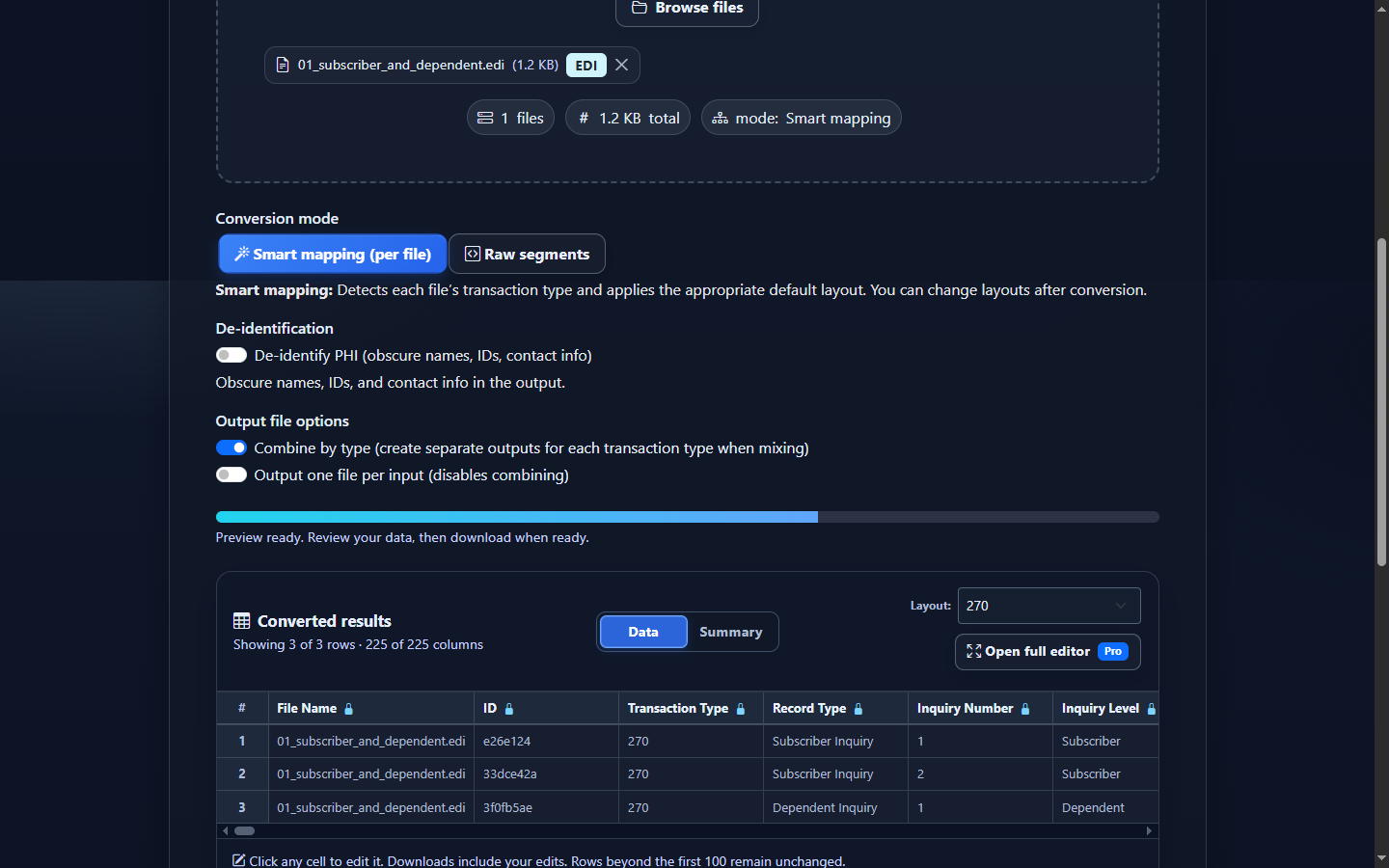
- Select Convert & Preview to inspect labeled subscriber, dependent, date, trace, and requested-service fields.
- Select Open full editor when you need filters, sorting, column controls, saved layouts, or converted-data review.
- Open Validation Results to review enabled structural, required-data, format, code, and consistency checks. “No issues found” applies only to those enabled checks.
- Select Analysis to review inquiry counts, patient mix, requested service types, date coverage, identifiers, and detail rows.
- Use Download to export Excel, CSV, JSON, or XML after confirming the fields needed to reconstruct hierarchy remain included.
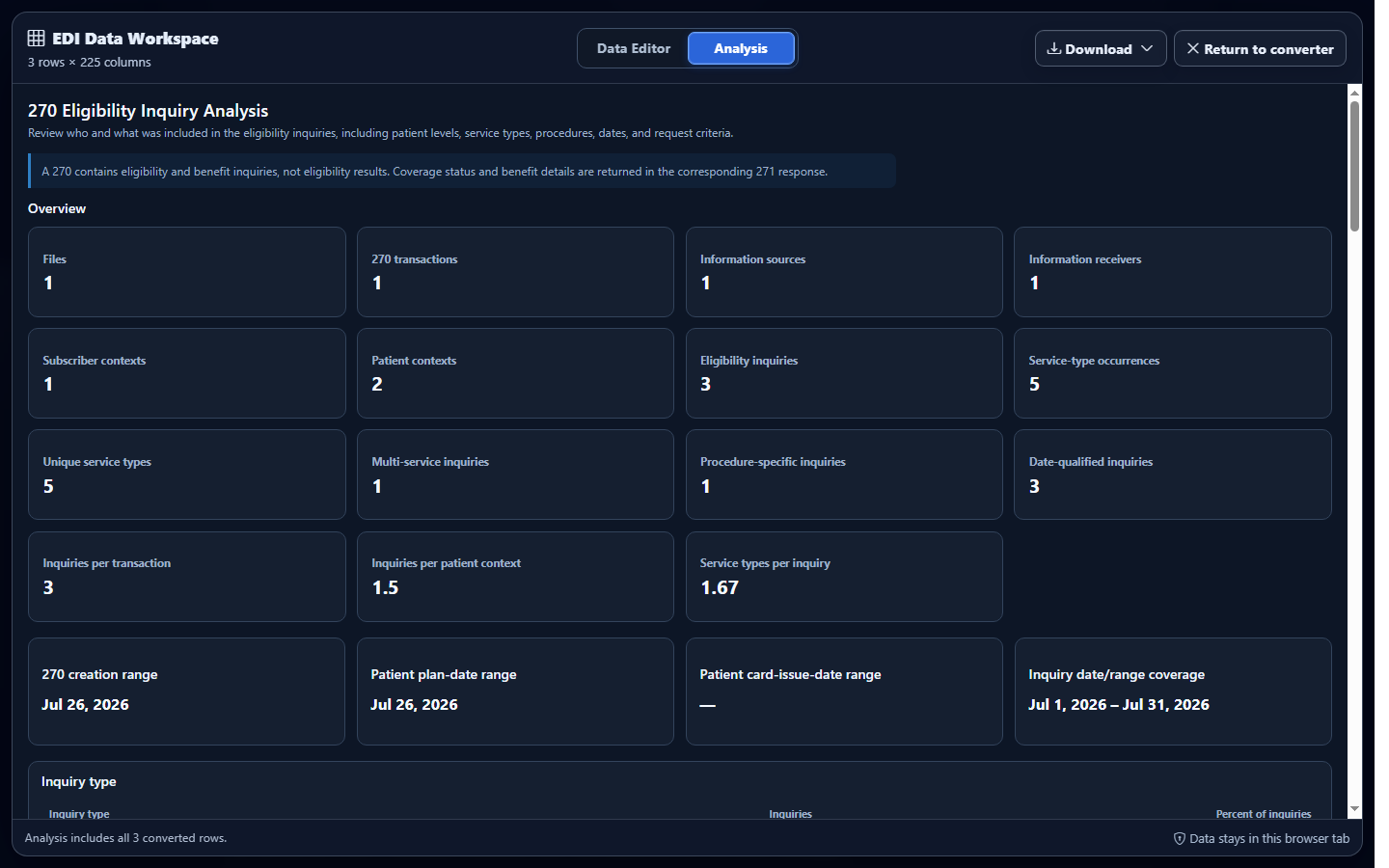
Important limitation: editing converted values does not rewrite the uploaded source EDI. The validator checks supported rules but does not determine whether a patient is eligible or what benefits are available. Trading partners may apply additional requirements.
Common EDI 270 mistakes and interpretation risks
Confusing the inquiry with the response
Seeing a service type in EQ means that information was requested. It does not mean the service is covered. Review the matched EDI 271 and its benefit or rejection context.
Losing subscriber and dependent hierarchy
A dependent level relies on its subscriber parent. Keep HL identifiers, patient type, subscriber identifiers, patient identifiers, and trace values together when converting or joining data.
Dropping leading zeros from identifiers
Spreadsheet software can coerce trace, member, group, and control values into numbers. Import them as text and verify the exported result before using it for reconciliation.
Reading a date without its qualifier and format
DTP03 is only the value. Retain DTP01 and DTP02 so a single date and a range are interpreted correctly and so the business meaning is not guessed.
Sending insufficient or inconsistent lookup data
A receiver needs appropriate patient and subscriber context. Review missing identifier pairs, demographic combinations, patient trace values, and the current hierarchy. Correct only against authorized source information and the relevant companion guide.
Assuming base validation guarantees a successful response
Envelope counts and required structures can be correct while a receiver applies additional business rules. Validation reduces avoidable defects but cannot guarantee matching, returned benefits, authorization, or payment.
Frequently asked questions
What is an EDI 270 eligibility inquiry?
It is the X12 transaction used to request eligibility and benefit information for a subscriber or dependent from a health plan or another information source.
Who sends and receives an EDI 270?
Authorized providers, facilities, pharmacies, clearinghouses, and service organizations commonly send inquiries. Health plans or their eligibility services receive them and typically return a 271.
Does a 270 prove that a patient is eligible?
No. The 270 contains the question. Review the receiver’s 271 response for the supplied eligibility and benefit information, while recognizing that it is not a payment guarantee.
What implementation does this guide cover?
It covers the 005010X279A1 Health Care Eligibility Benefit Inquiry supported by the application.
Can a 270 ask about a dependent?
Yes. The dependent is represented beneath the applicable subscriber in the HL hierarchy and must retain the subscriber lookup context.
What does EQ mean in a 270?
EQ identifies the service type or procedure context being requested. Read its components with the patient hierarchy and applicable qualifiers.