Enrollment validation guide
How to Validate an EDI 834 File
Check enrollment maintenance at the transaction, member, coverage, and nested-loop levels without treating file conformance as proof that a payer applied the enrollment.
To validate an EDI 834 file, verify the X12 controls and 005010X220A1 identity, confirm BGN, sponsor, payer, and member structures, then review each INS member action and HD coverage action in context. Test dates, coverage chronology, amounts, quantities, paired identifiers, ID-card requests, provider and coordination-of-benefits loops, and reporting boundaries. Correct source defects and rerun validation. A clean result means no issues were found by enabled checks; it does not prove that enrollment was accepted or applied.
What validating an EDI 834 means
An EDI 834 Benefit Enrollment and Maintenance transaction communicates enrollment additions, changes, terminations, reinstatements, and related member or coverage information between sponsors, administrators, health plans, and other trading partners. The current smart mapper and validator recognize 005010X220A1.
The public validator currently exposes 44 active 834 rules. Structural findings 834-LOOP-002 (provider outside coverage) and 834-LOOP-005 (reporting category outside LS/LE) are Errors. Coverage chronology is a Warning. Issue identity is member-local: coverage numbering restarts within each member and coverage-owned findings retain that member's Coverage Number. Unknown source codes are preserved and labeled as unknown rather than discarded.
Validation asks whether the supplied transaction is structurally coherent and whether enabled rules find requiredness, format, code, pairing, chronology, or loop-context concerns. It does not contact the payer or prove that its enrollment system accepted or applied a maintenance action. Reconcile acknowledgments and downstream enrollment reports separately.
What to check in a 005010X220A1 enrollment file
| Area | Representative check | Why it matters |
|---|---|---|
| Controls | ISA/IEA, GS/GE, and ST/SE controls and counts agree; ST01 and implementation version identify the supported 834. | Broken controls can prevent reliable interchange or transaction processing. |
| Header parties | BGN is present with a real BGN03 date; required sponsor N1*P5 and payer N1*IN contexts exist. | The transaction needs an identifiable beginning, sponsor, and payer scope. |
| Member maintenance | INS01 contains a supported subscriber indicator and INS03 identifies the maintenance action. | The member action cannot be interpreted reliably without its maintenance context. |
| Coverage maintenance | HD belongs to an INS member; HD01 identifies the action and HD03 identifies the insurance line. | Coverage changes must remain attached to the correct member and benefit line. |
| Dates and chronology | DTP qualifier, format, and value are complete; dates are real; coverage end does not precede begin. | Effective and termination timing controls how maintenance is applied. |
| Nested data | AMT, QTY, IDC, provider, COB, reporting, contact, and identifier values appear in valid contexts with required paired values. | Flattened review must not detach nested details from their owner. |
Scope: These checks do not replace the licensed implementation guide or a trading partner’s companion guide. Partner rules may add situational requirements and code restrictions.
Keep transaction, member, coverage, and nested scope separate
INS starts a member context. INS01 distinguishes subscriber status, while INS03 identifies the member maintenance action. HD starts coverage maintenance under that member; HD01 supplies its action and HD03 identifies the insurance line. One member can carry multiple HD occurrences, and each coverage can own dates, amounts, identifiers, providers, ID-card requests, and coordination-of-benefits data.
Not every legitimate member action necessarily contains an HD occurrence. Review the member maintenance code, available data, and partner rules before labeling a member-only row incomplete. Conversely, an HD outside an active INS context is a structural problem because its owner is unresolved.
Controlled invalid enrollment date and corrected source
This shortened synthetic transaction contains no real protected health information (PHI). It deliberately uses 20260229 in BGN03. Because 2026 is not a leap year, the value is not a real calendar date.
Invalid source
ST*834*0001*005010X220A1~
BGN*00*VALIDATION834*20260229*1200~
N1*P5*TEST SPONSOR*FI*001234567~
N1*IN*TEST PAYER*NI*00001~
INS*Y*18*021**A***FT~
REF*0F*00001234~
NM1*IL*1*MEMBER*TEST****MI*00001234~
HD*021**HLT*TEST PLAN*EMP~
DTP*348*D8*20260301~
SE*10*0001~
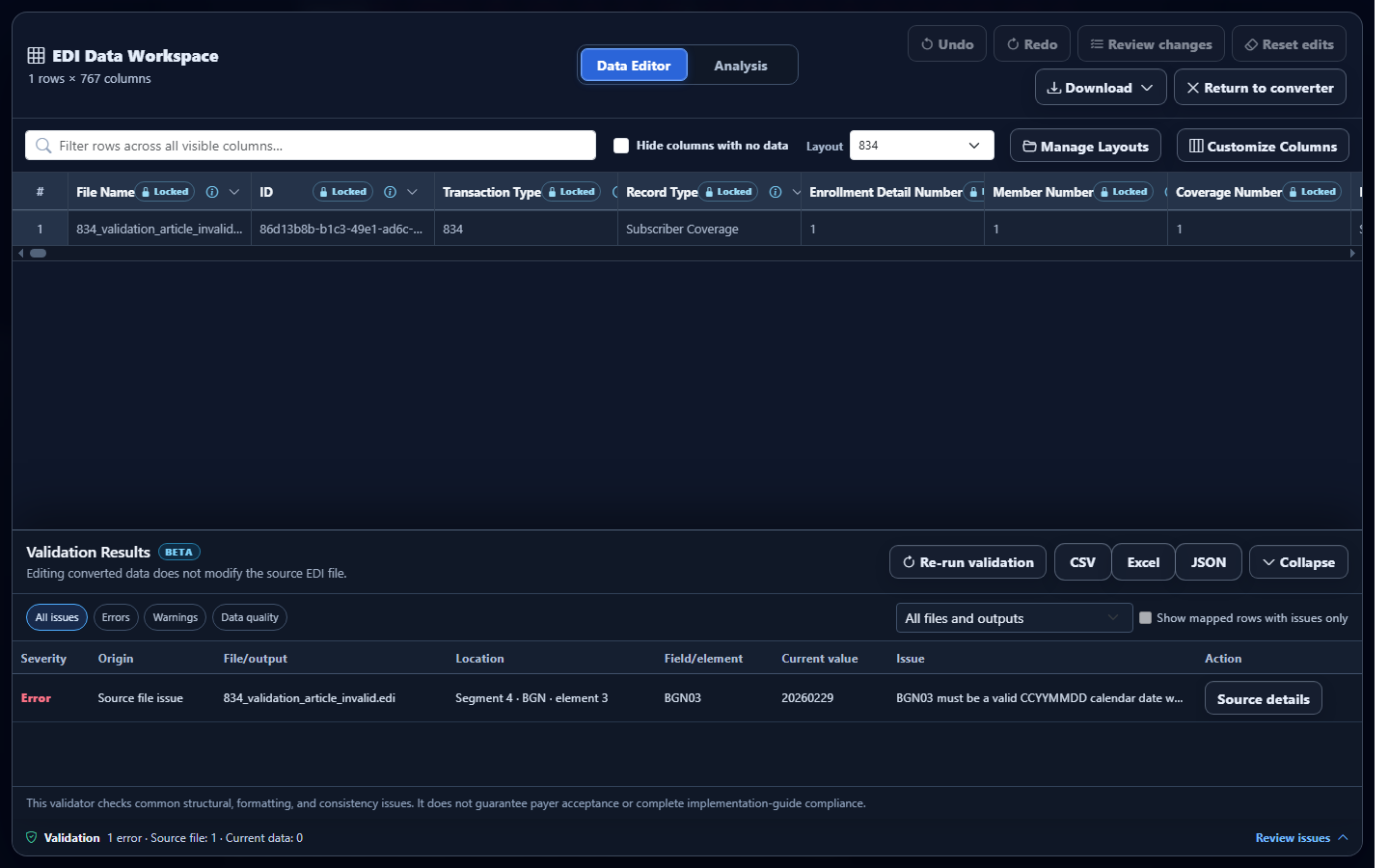
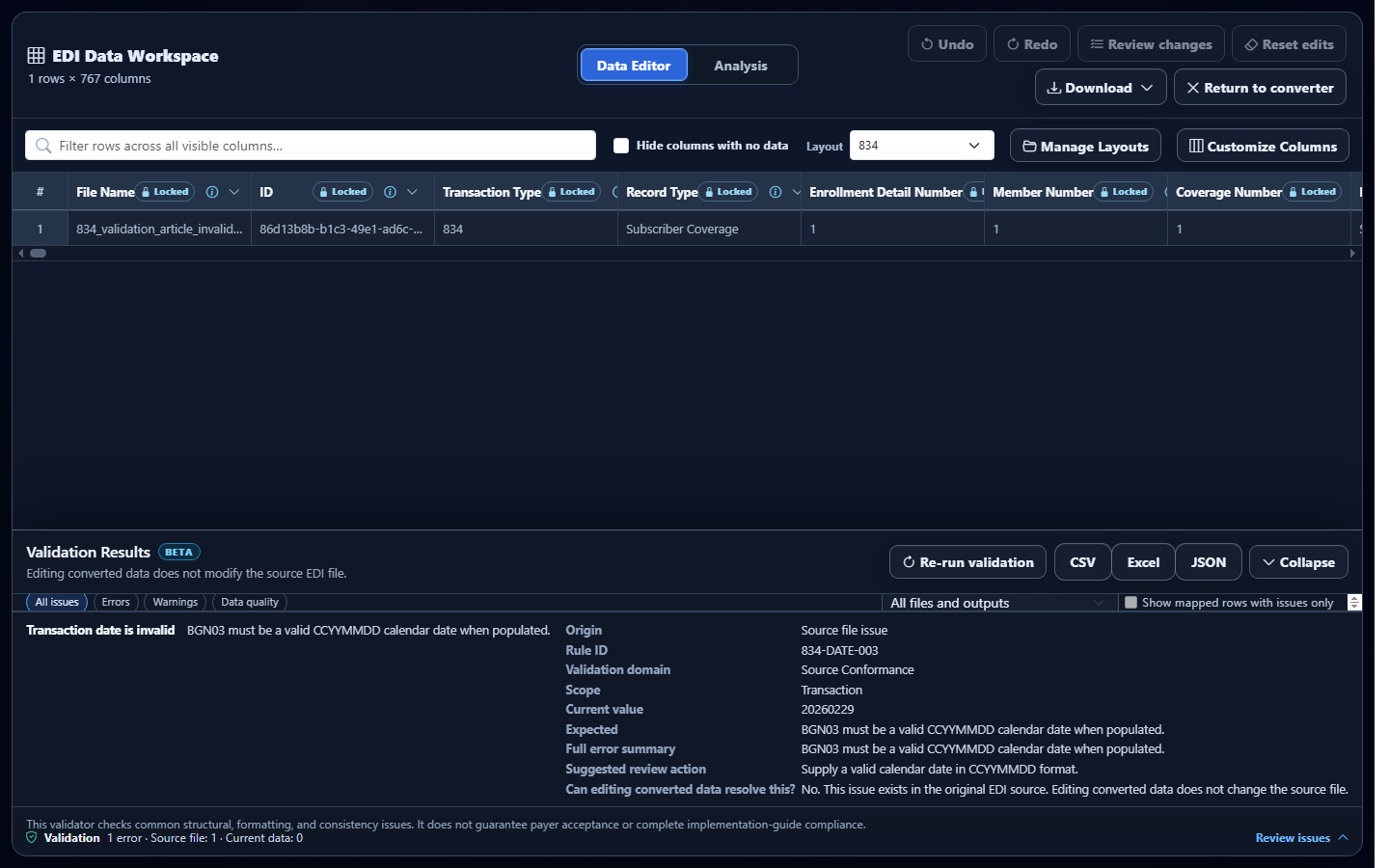
Observed validator result: the actual validator reports Transaction date is invalid, applies rule 834-DATE-003, and locates BGN element 3 with current value 20260229.
Corrected source
ST*834*0001*005010X220A1~
BGN*00*VALIDATION834*20260228*1200~
N1*P5*TEST SPONSOR*FI*001234567~
N1*IN*TEST PAYER*NI*00001~
INS*Y*18*021**A***FT~
REF*0F*00001234~
NM1*IL*1*MEMBER*TEST****MI*00001234~
HD*021**HLT*TEST PLAN*EMP~
DTP*348*D8*20260301~
SE*10*0001~
Regenerating BGN03 as 20260228 clears this controlled date error. It does not change the member or coverage maintenance action.
Validate the 834 in EDIFileConverter.com
- Open the EDI converter and validator. Add the authorized enrollment file through Browse files or Drag & drop EDI files. Processing occurs in the browser tab without application-server upload.
- Keep Smart mapping (per file) selected. The application identifies 005010X220A1 and maps member and coverage rows while retaining nested occurrence context.
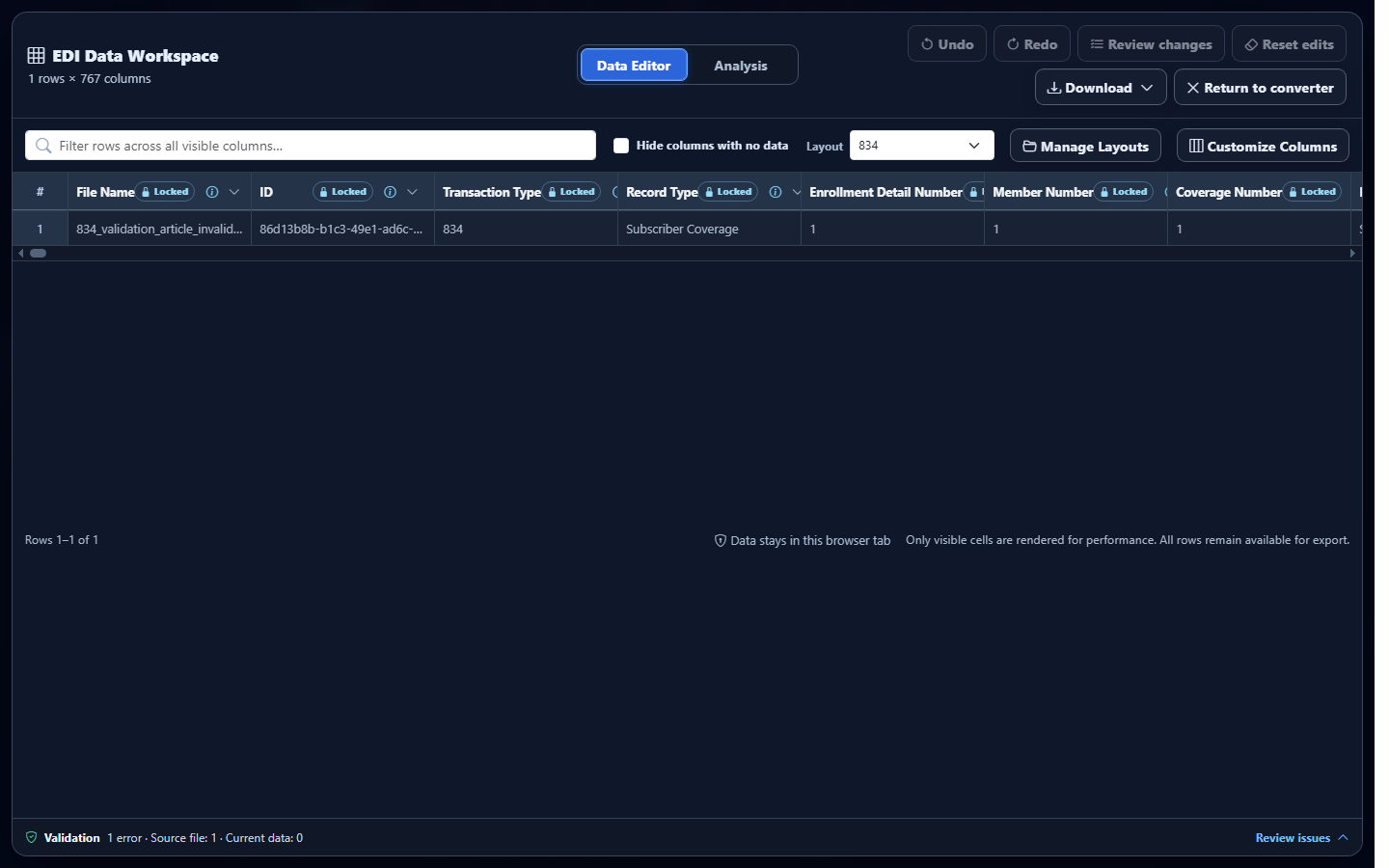
- Select Convert & Preview. Confirm Converted results identifies 834, then spot-check member maintenance, subscriber indicator, coverage maintenance, insurance line, dates, and identifiers.
- Select Open full editor. Expand Validation in Data Editor to open Validation Results.
- Filter by severity or domain. Use Errors, Warnings, EDI structure, Required data, and Data quality to narrow the result.
- Open Source details. Review the rule ID, member or coverage scope, segment location, current value, expected condition, and suggested corrective action.
- Correct the producing system. Fix source-conformance defects where the enrollment was generated. Editing converted data does not rewrite the uploaded EDI.
- Replace and rerun. Add the corrected file and choose Re-run validation. Eligible plans can export a validation report as CSV, Excel, or JSON.
Common EDI 834 validation issues and cautious fixes
Missing BGN, sponsor, payer, or member structure
What you see: requiredness errors at transaction scope. Why it matters: enrollment maintenance lacks a required owner or starting context. Review: BGN, N1*P5, N1*IN, and INS placement. Correction: repair transaction generation and recalculate SE01.
Missing INS03 or HD maintenance data
What you see: missing member action, coverage action, or insurance line. Why it matters: the receiver cannot reliably determine what enrollment change to apply. Review: INS and each HD occurrence. Correction: derive the action from the authoritative enrollment event; do not copy a code from another member.
Coverage end before coverage begin
What you see: a chronology warning tied to member and coverage numbers. Why it matters: benefit timing is internally inconsistent. Review: DTP*348 and DTP*349 under the same HD. Correction: confirm the intended effective and termination dates before regenerating the file.
Provider, COB, or ID-card data outside coverage
What you see: loop-context or paired-value issues. Why it matters: nested details cannot be assigned to the intended coverage. Review: the preceding INS, HD, LX, NM1, COB, and IDC boundaries. Correction: repair loop serialization rather than moving a single segment without its related data.
Invalid amount, quantity, or identifier pair
What you see: finite-decimal, positive-integer, or qualifier/value pairing errors. Why it matters: values without qualifiers or identifiers without their partner are ambiguous. Review: AMT, QTY, IDC, REF, PER, or provider NM1 elements together. Correction: restore the complete pair using authoritative source data.
Frequently asked questions
What does an EDI 834 validator check?
It checks enabled envelope, required-loop, maintenance, date, amount, quantity, pairing, nested-context, and consistency rules.
Does a valid 834 prove enrollment was accepted?
No. It means no issues were found by enabled checks. It does not prove a payer accepted or applied the enrollment.
Which implementation is recognized?
The current workflow recognizes 005010X220A1.
Can a member exist without an HD coverage loop?
Some member-level maintenance can be represented without coverage. Interpret INS03 and partner rules before assuming HD is missing.
Does editing converted data rewrite the source?
No. Data Editor changes affect converted output and downloads, not the uploaded EDI.