Enrollment reading guide
How to Read an EDI 834 File
Follow enrollment maintenance from the transaction reference to each member and repeating coverage occurrence.
To read an EDI 834 file, confirm transaction 834 and implementation 005010X220A1, reconcile envelope controls, and read BGN transaction context before entering each INS member record. Keep member maintenance codes, relationship, identifiers, and qualified dates together. For every repeating HD coverage occurrence, retain its maintenance type, insurance line, plan, coverage level, dates, amounts, references, and occurrence number. A transmitted action is not proof that the receiver accepted or applied it.
Read an 834 in this sequence
- Confirm the transaction. Check ST01 for 834 and ST03 for 005010X220A1; match ST02 and SE02.
- Reconcile envelopes. Preserve ISA/IEA and GS/GE senders, receivers, controls, and counts.
- Read BGN. Retain purpose, reference, creation date, and time for the enrollment batch.
- Identify organizations. Read N1 entity and identifier qualifiers before labeling sponsor, payer, broker, or other parties.
- Start each member at INS. Interpret subscriber indicator, relationship, maintenance type and reason, benefit status, and employment context together.
- Match the member. Keep REF identifiers, NM1 identity, demographics, addresses, and member dates with the current INS.
- Read every HD. Treat each coverage as a separate occurrence with its own plan, level, dates, amounts, and references.
- Reconcile outcomes separately. Confirm receiver acceptance through the applicable trading-partner process.
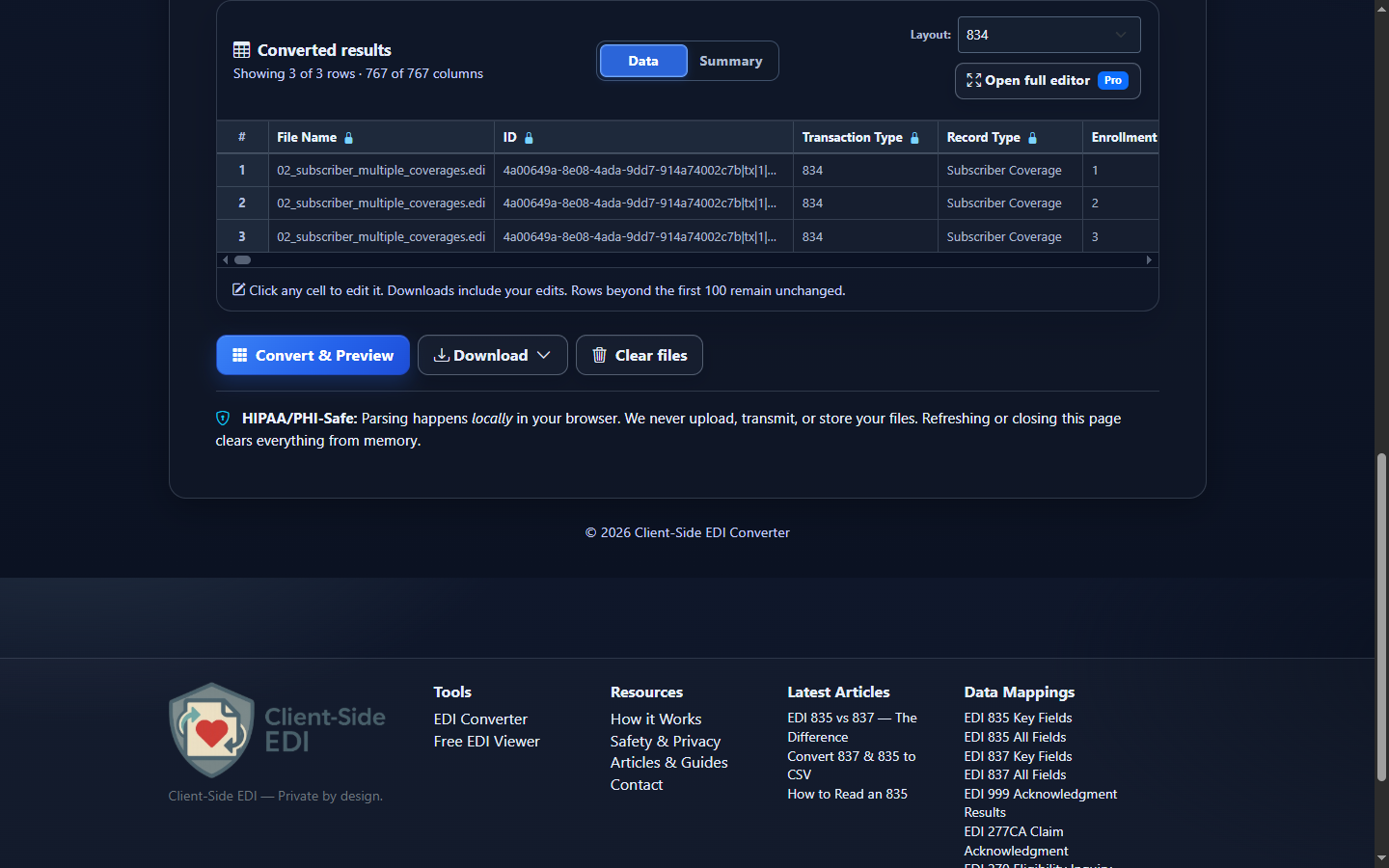
Read member ownership before maintenance codes
| Context | Fields to retain | Question |
|---|---|---|
| Member owner | Member Number, subscriber indicator, relationship, member ID, group/policy references | Who does this record describe? |
| Maintenance | Maintenance type, reason, benefit status, employment status | What action or status is being communicated? |
| Identity | NM1 qualifier and ID, name, DMG date format/date, address | Which person should the receiver match? |
| Dates | DTP qualifier, format, value, and member/coverage owner | What event and effective period does the date represent? |
Do not label a member from INS03 alone. Maintenance meaning depends on related values, dates, trading-partner rules, and whether the record is a subscriber or dependent. Treat leading-zero identifiers as text.
Keep repeated HD coverage records separate
One member may have medical, dental, vision, or other HD occurrences. Each can carry a different maintenance type, insurance line, plan description, coverage level, begin or end date, premium amount, policy reference, and card information. Counting HD rows as members inflates enrollment totals; collapsing them can erase valid elections.
Reliable flat output: retain File, Member Number, Coverage Number, maintenance fields, member and policy identifiers, insurance line, plan, coverage level, qualified dates, and occurrence-specific amounts.
Read this synthetic EDI 834 example
ST*834*0001*005010X220A1~
BGN*00*REF0001*20260727*1200~
N1*P5*TEST SPONSOR*FI*001234567~
N1*IN*TEST PAYER*NI*00001~
INS*Y*18*021**A***FT~
REF*0F*00001234~
NM1*IL*1*MEMBER00001234*TEST****MI*00001234~
DMG*D8*19800101*M~
HD*021**HLT*TEST PLAN*EMP~
DTP*348*D8*20260801~
AMT*P3*00125.50~
SE*12*0001~
ST and BGN identify the transaction. N1 identifies fictional parties. INS begins subscriber maintenance, REF and NM1 preserve the leading-zero ID, and DMG supplies fictional demographics. HD begins health coverage; DTP and AMT add qualified coverage context. SE reports 12 segments and repeats control 0001.
Read an 834 in EDIFileConverter.com
- Open the EDI workspace and add an authorized file with Browse files.
- Keep Smart mapping (per file) selected and confirm 005010X220A1.
- Select Convert & Preview; begin with Member Number, Coverage Number, maintenance, identifiers, and dates.
- Select Open full editor for filters and column controls while retaining ownership fields.
- Use Validation Results for enabled checks and Analysis for member, maintenance, and coverage summaries.
- Use Download for Excel, CSV, JSON, or XML after verifying occurrence context.
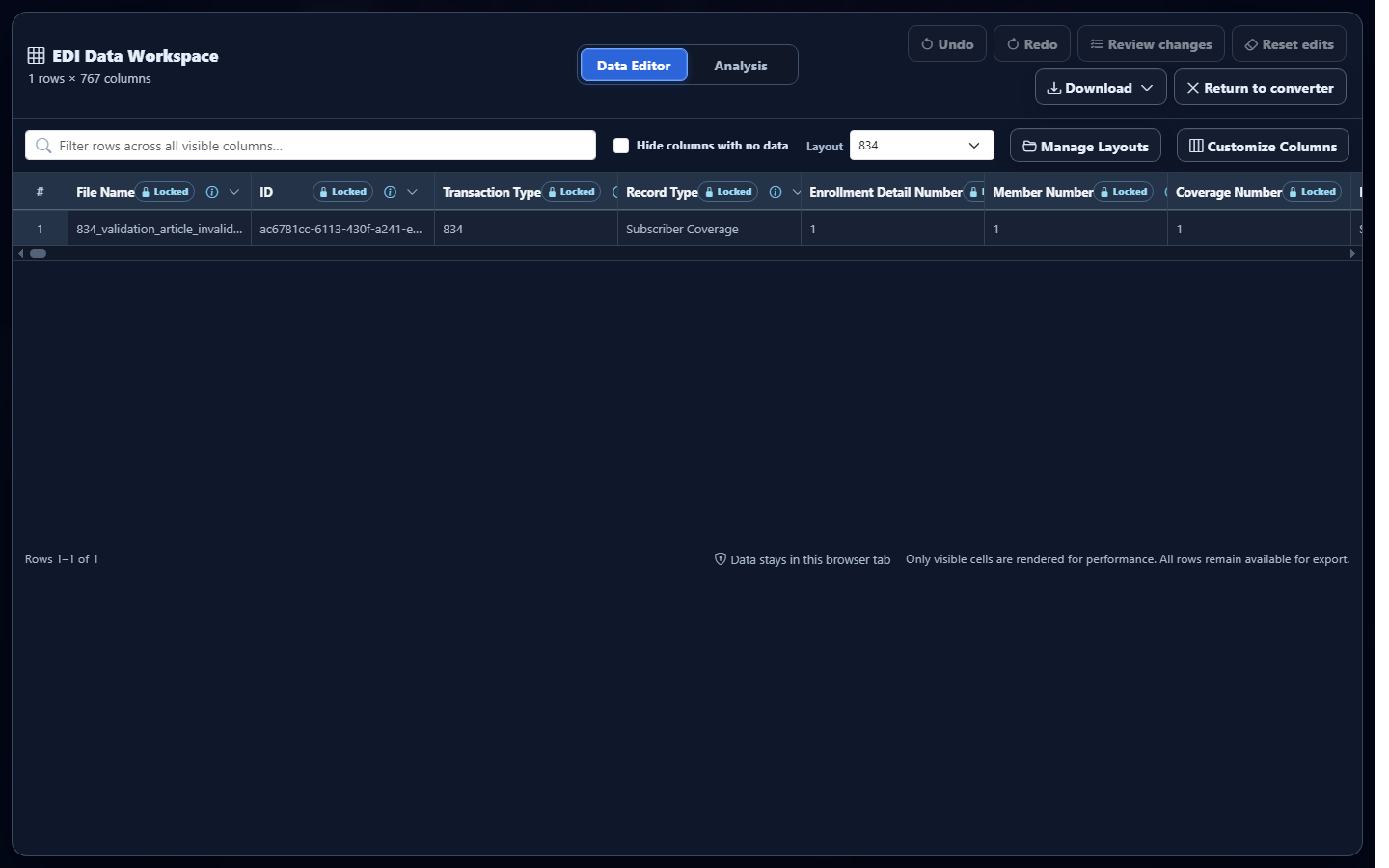
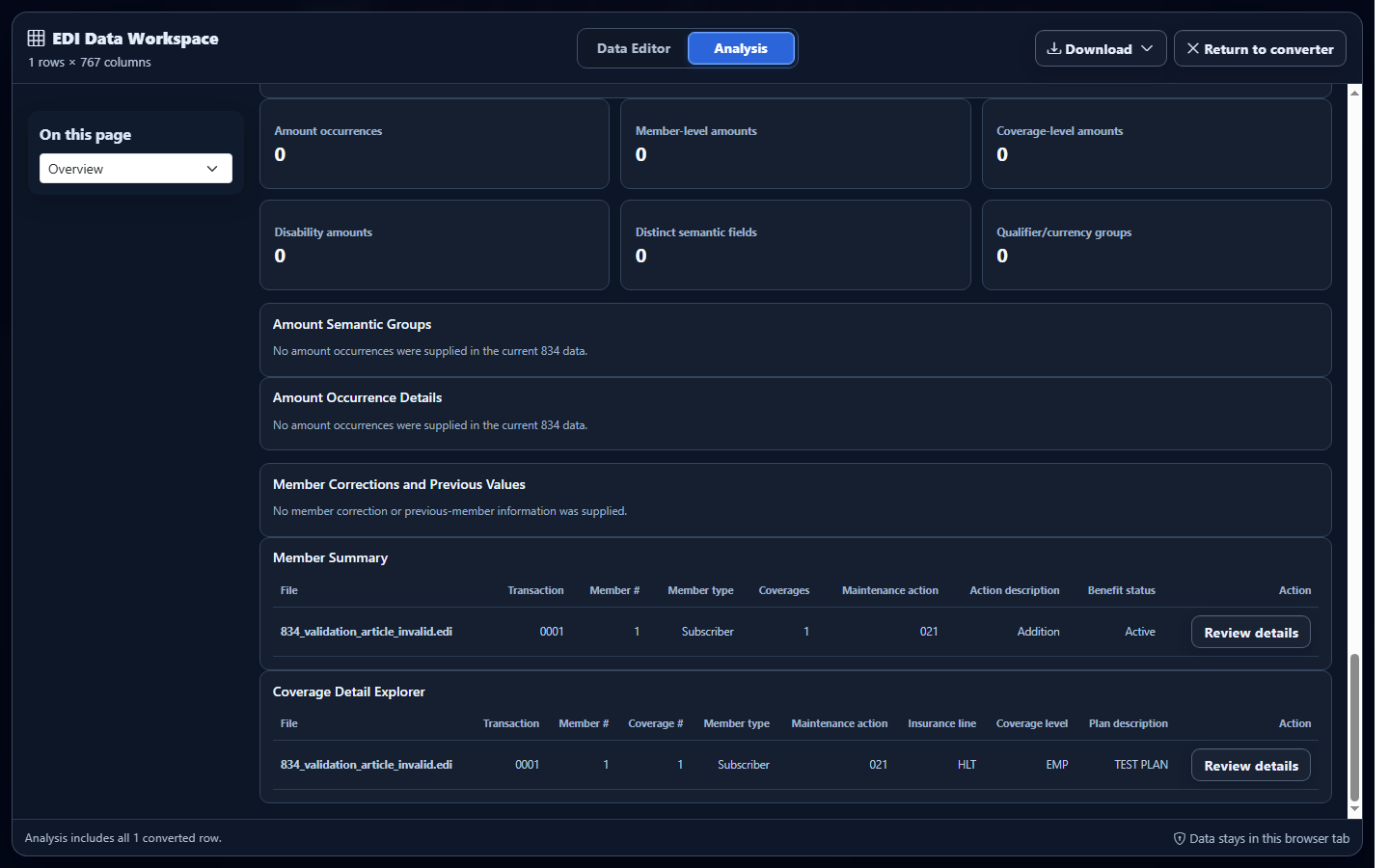
Editing converted rows does not rewrite the source EDI, and enabled validation does not prove receiver acceptance.
Common mistakes when reading an 834
Counting HD rows as members
Count stable member records separately from coverage occurrences.
Reading maintenance codes alone
Include reason, relationship, status, dates, and owner before assigning meaning.
Dropping leading zeros
Member, policy, group, and control values are identifiers, not quantities.
Detaching dates from qualifiers
Keep DTP01, DTP02, DTP03, and the member or coverage owner together.
Assuming valid means accepted
Trading partners may apply additional rules and return separate acceptance information.
Frequently asked questions
What should I read first?
Confirm 834 and 005010X220A1, reconcile controls, read BGN, then begin each member at INS.
What do INS and HD mean?
INS begins member context; HD begins a coverage occurrence owned by that member.
Can one member have multiple coverages?
Yes. Preserve every HD occurrence and its dates and related details.
Does valid mean accepted?
No. Enabled checks do not prove the receiver applied enrollment.