Eligibility-response editing guide
How to Edit an EDI 271 File
Change mapped response data for downstream analysis or export while preserving subscriber, dependent, provider, trace, and service-type context.
To edit an EDI 271 file, convert the 005010X279A1 eligibility response with Smart mapping, open the full Data Editor, locate the correct subscriber or dependent response row, and change an unlocked converted field. Verify the change with Undo, Redo, Review changes, or Reset edits, then export the revised representation as Excel, CSV, JSON, or XML. This workflow does not rewrite the uploaded X12 source, send a new eligibility response, alter the payer’s records, or produce a 271 eligibility response.
What editing a 271 does—and does not do
An EDI 271 Eligibility, Coverage or Benefit Response answers an eligibility inquiry with payer-supplied eligibility and benefit information. The 005010X279A1 transaction can identify the information source, information receiver, subscriber, and—when applicable—a dependent. EB segments describe eligibility and benefit information; AAA segments can report response rejections; and TRN, REF, DTP, NM1, DMG, and related segments contribute trace, identifier, date, demographic, and party context.
EDIFileConverter.com maps that hierarchy into labeled response rows. The Data Editor changes the converted representation used for review and download. This is useful for annotating an internal dataset, normalizing a display value, correcting a downstream import value, or preparing a reviewed extract. It is not an EDI authoring or transmission tool. The original file remains intact, and a changed row cannot establish whether a patient is eligible or what benefits are available.
Editing a converted 271 does not contact the payer, change an AAA rejection, or create new coverage or benefit facts. Any operational correction intended for submission should be made in the authoritative source system and regenerated under the applicable trading-partner rules.
Select the correct response and hierarchy level
| Context | Fields to verify | Why it matters |
|---|---|---|
| Information source | Payer name and identifier in the source-level hierarchy. | The same receiver may send inquiries to different plans. |
| Information receiver | Provider name, identifier, taxonomy, address, and receiver hierarchy. | Receiver identity can affect routing and partner requirements. |
| Subscriber | Member identifier, name, date of birth, relationship, trace, and response number. | Several response rows can share one subscriber context. |
| Dependent | Dependent identity, relationship, parent subscriber, and patient type. | Do not overwrite subscriber data when the EB or AAA response detail belongs to a dependent. |
| Benefit detail | EB03 service-type codes, EB13 procedure composite, benefit DTP dates, and Response Detail Number. | One patient can have several distinct returned benefit categories. |
Search for stable identifiers such as the eligibility trace number, member identifier, or response reference. Then verify Response Level, Patient Type, service-type fields, and the source hierarchy before editing. Protected workspace columns remain locked; unlocked columns are part of the converted output.
Important: Preserve leading zeros in member, trace, and reference identifiers. If a source value must change for transmission, correct the generating system and rebuild the X12 controls and counts rather than treating the edited spreadsheet-like result as a replacement EDI file.
Original and edited converted response values
The screenshot fixture is synthetic and contains fictional names, identifiers, addresses, and dates. Its supported transaction header and benefit detail include:
ST*271*000000001*005010X279A1~
HL*1**20*1~
NM1*PR*2*SYNTHETIC HEALTH PLAN*****PI*PAYER001~
EB*1*IND*30**SYNTHETIC GOLD PLAN~
ST03 is the implementation convention/version identifier. The editor demonstration changes a mapped plan-description field, not the routing version:
| Field context | Original converted value | Edited export value |
|---|---|---|
| Plan Coverage Description (EB05) | SYNTHETIC GOLD PLAN | REVIEWED PLAN LABEL |
The analyst label demonstrates the converted-data editor. The uploaded source remains ST*271*000000001*005010X279A1~ and its EB05 remains unchanged.
Edit converted EDI 271 data in the application
- Open the EDI converter and Data Editor. Add an authorized response using Browse files or Drag & drop EDI files. Processing occurs in the browser tab without application-server upload.
- Keep Smart mapping (per file) selected. Confirm the application identifies transaction 271 and implementation 005010X279A1.
- Select Convert & Preview. Verify the transaction reference, response level, patient type, member and provider identifiers, date, and requested service types in Converted results.
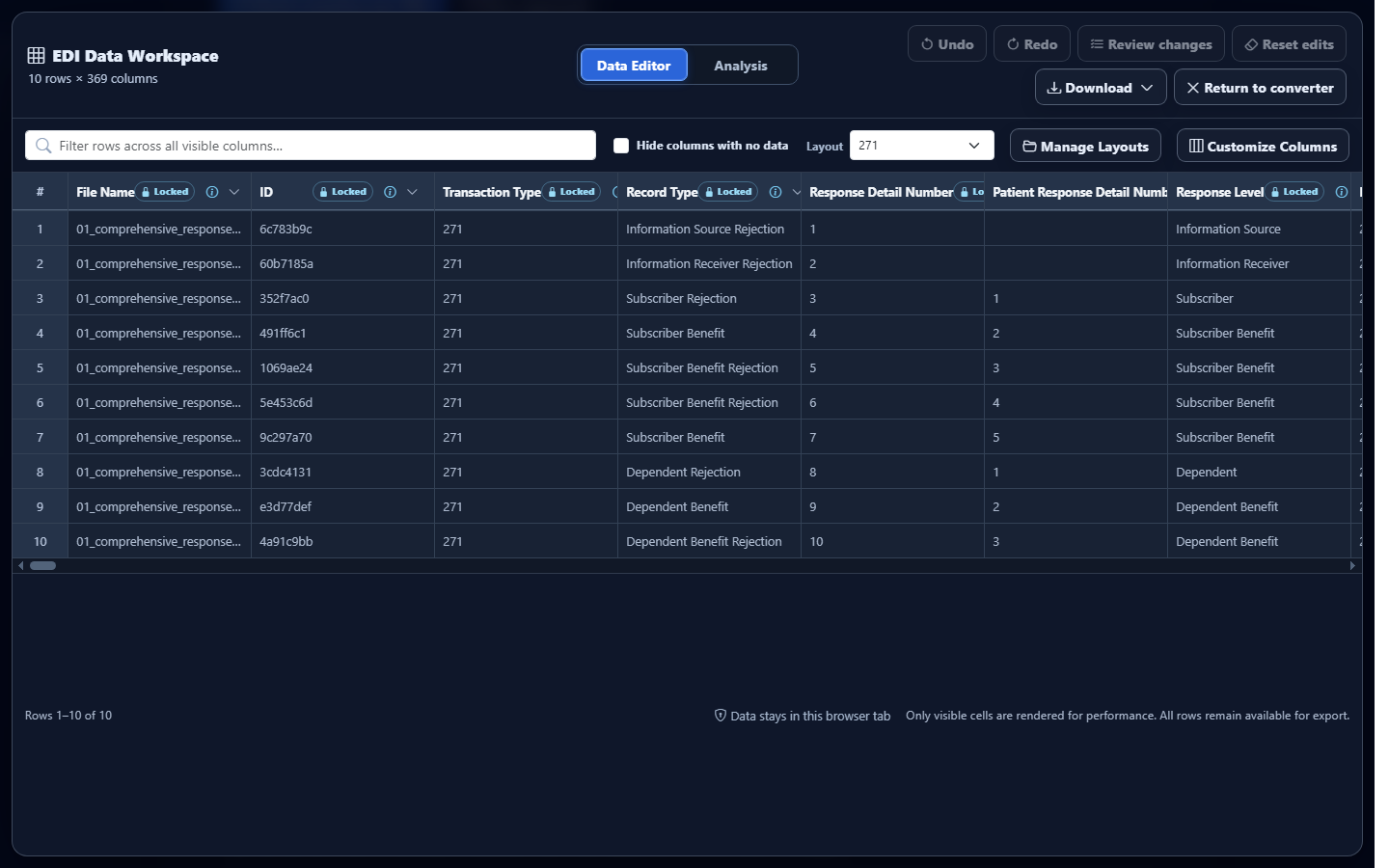
- Select Open full editor. The EDI Data Workspace opens on Data Editor with row and column counts, layout controls, and protected context columns.
- Find the intended row. Use Filter rows across all visible columns, column menus, or Layout. Hide columns with no data can simplify sparse output, but keep the identifiers needed to establish ownership.
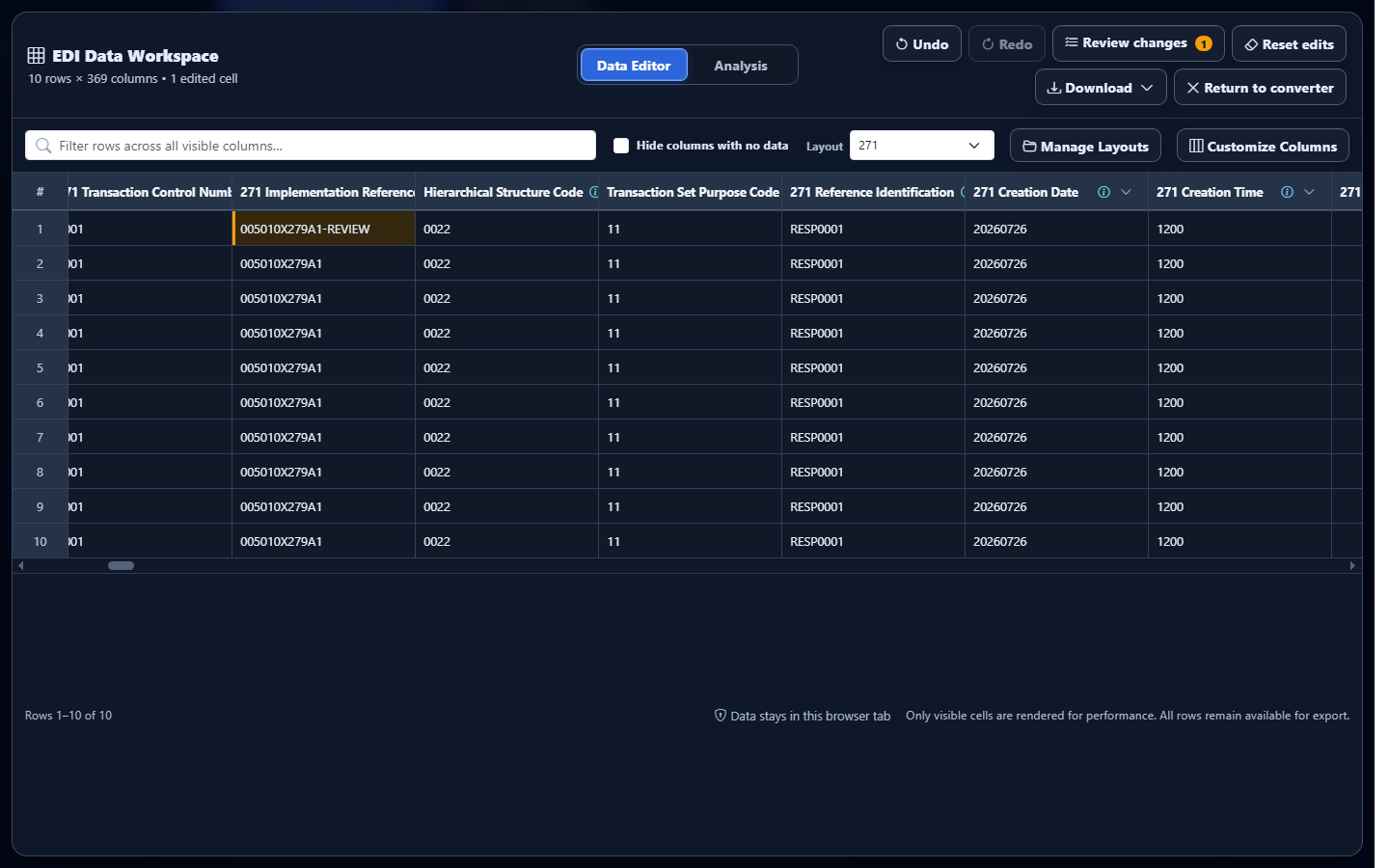
- Edit an unlocked cell. Enter the reviewed value and press Enter or move focus away. The workspace marks the edited cell and updates the edited-cell count.
Review, revert, and export the change
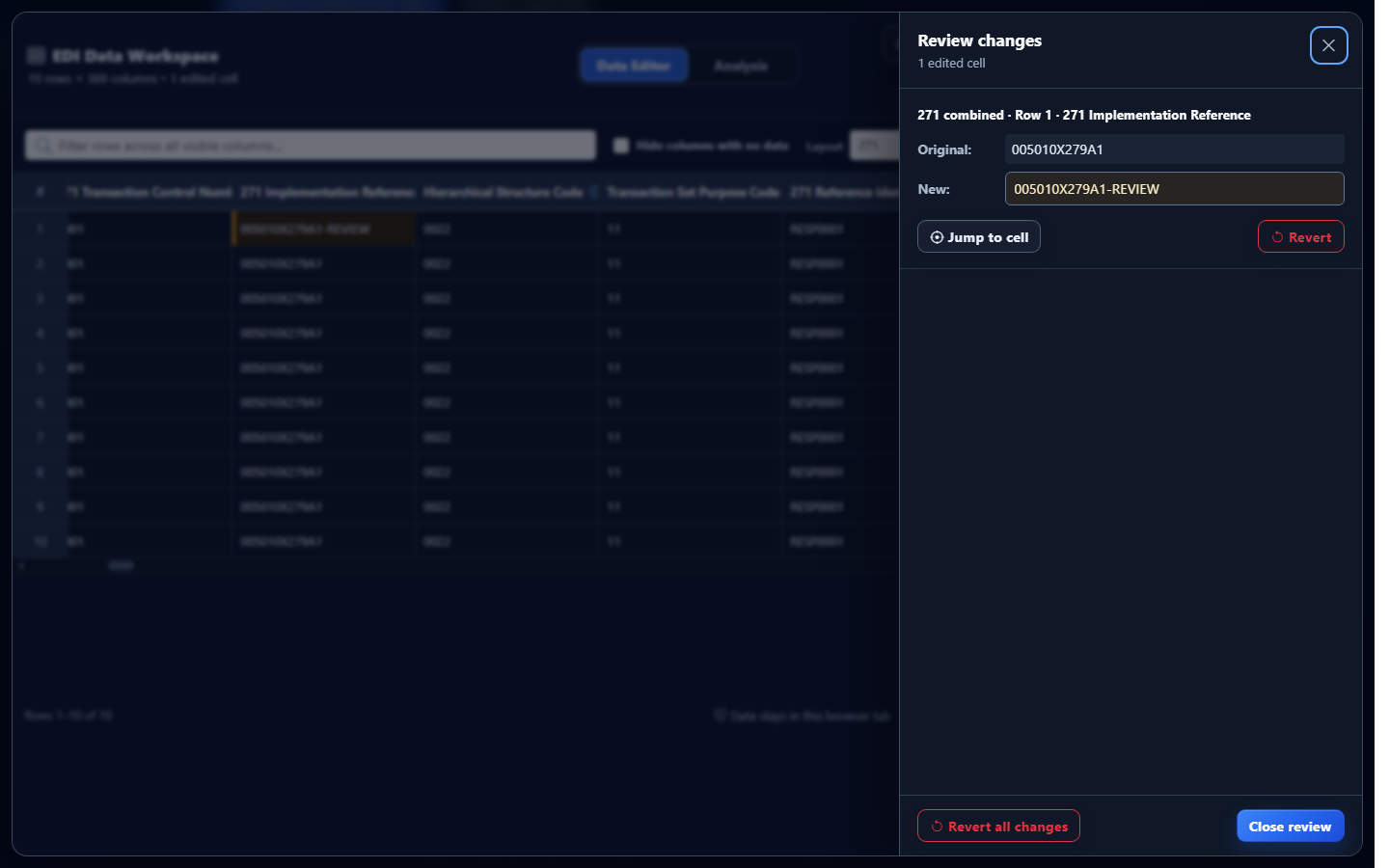
Select Review changes before downloading. The panel identifies the mapped output, row, field, original value, and new value. Use Undo and Redo for recent edits. Use the per-change Revert control, Revert all changes, or Reset edits according to the scope you intend to discard.
Open Download and select Excel, CSV, JSON, or XML. Excel suits a reviewed workbook, CSV supports flat imports, JSON supplies explicit field names for application workflows, and XML supplies structured elements for integration workflows. Each includes committed converted-data edits. Retain response number, hierarchy level, patient type, trace, member, provider, service type, and date fields when a downstream consumer must distinguish repeated requests.
Common EDI 271 editing mistakes
Editing the wrong patient occurrence
What you see: similar subscriber and dependent rows. Why it matters: an EB or AAA response detail belongs to a specific hierarchy node. Review: Response Level, Patient Type, member identifier, and relationship. Correction: revert the wrong edit and locate the intended row through stable identifiers.
Removing leading zeros from identifiers
What you see: spreadsheet-style numeric coercion. Why it matters: identifiers are text and leading zeros may be significant. Review: original mapped value and export settings. Correction: preserve text formatting and compare the reviewed download.
Changing service types without their occurrence context
What you see: a revised EB03-derived value detached from related procedure or date fields. Why it matters: one patient can have multiple returned benefit categories. Review: response number, service-type list, procedure composite, and DTP qualifier. Correction: keep associated fields together in the export.
Assuming an edit updates eligibility
What you see: a cleaned dataset but no new response from a payer. Why it matters: eligibility information comes from the source 271, not from editing a converted representation. Correction: use the authorized inquiry and response workflow outside this editor.
Frequently asked questions
Does the Data Editor rewrite the original EDI 271?
No. It edits the converted representation used for review and download. The uploaded source remains unchanged.
Does editing a 271 change eligibility?
No. Editing converted data does not change payer-supplied coverage, benefits, or eligibility.
Which implementation is recognized?
Smart Mapping supports exact 005010X279A1 in ST03. If ST03 is blank, exact GS08 005010X279A1 is the fallback; near-match and unsupported versions are Raw-only.
Can edited data be downloaded?
Yes. The Data Editor offers Excel, CSV, JSON, and XML containing committed converted-data edits.
Can I undo a converted-data edit?
Yes. Use Undo, Redo, Review changes, Reset edits, or the available revert controls.